
El Niño and Rabi 2026–27: Water Management, Irrigation & Crop Insurance
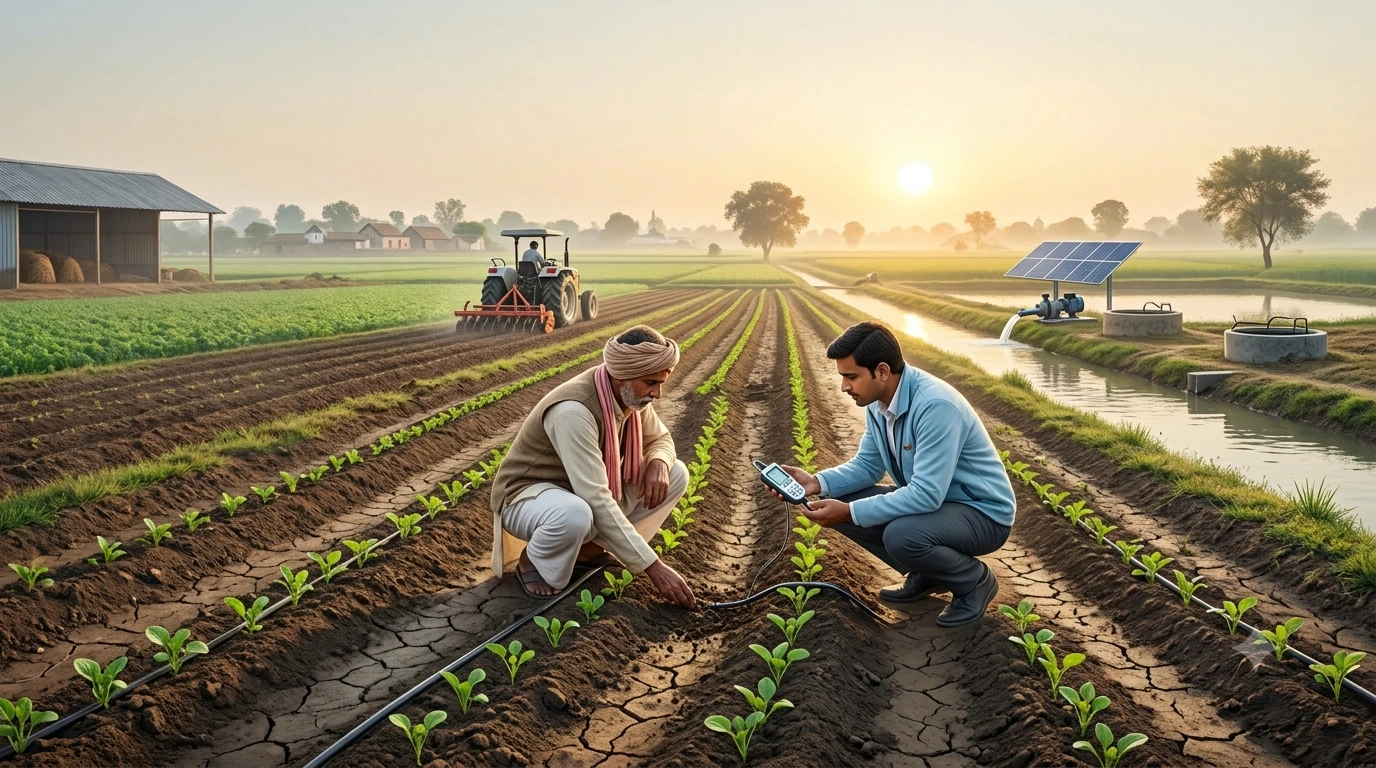
A weaker monsoon can leave farmers with lower soil moisture and less water available for irrigation during the rabi season. As farmers prepare for the 2026–27 winter cropping season, choosing the right crop, planning irrigation and protecting farm income will be especially important.
India Meteorological Department (IMD) forecasts indicated below-normal rainfall for the 2026 southwest monsoon, while El Niño conditions have raised concerns about weather variability. However, the impact will differ across states and districts, so farmers should base decisions on local rainfall, soil moisture, irrigation availability and agricultural advisories.
This guide explains how to assess water availability, compare suitable rabi crops, reduce irrigation requirements and manage financial risks. For a broader overview of seasonal crops, read our Rabi Crops in India 2026–27 guide.
How a Weak Monsoon Can Affect Rabi Crops
Rabi crops are generally sown from October to December and harvested in spring, depending on the crop and region. Unlike many kharif crops, they often rely heavily on stored soil moisture and irrigation.
A rainfall deficit during the monsoon can affect the rabi season in three main ways:
- Lower soil moisture: Fields may have less stored water to support germination and early crop growth.
- Reduced irrigation availability: Reservoirs, canals and groundwater sources may face pressure, although the impact varies by location.
- Heat-related risks: If winter and spring temperatures rise, wheat may experience heat stress during grain filling, potentially reducing yield.
El Niño can influence rainfall and temperature patterns, but it does not guarantee drought or crop losses in every region. Farmers should monitor local IMD forecasts and district-level agriculture advisories rather than assume uniform conditions across India.
The government has also set a rabi foodgrain production target of 177.72 million tonnes for 2026–27 and is encouraging a shift from water-intensive crops to pulses, oilseeds and millets. MSP increases this year are also strongest for oilseeds and pulses.
Assess Your Water Availability Before Sowing
Before selecting a crop, estimate how much water you can reliably access between sowing and harvest.
Check your borewell or open well, canal schedule, pump capacity and expected rainfall. Also assess the soil's moisture-retention capacity. Sandy soils generally lose moisture faster than loamy or clay-rich soils, although drainage and field conditions also matter.
Use this table as a starting point, not a fixed recommendation.
Water availability |
Crops to consider |
|---|---|
| Assured irrigation throughout the season | Wheat, mustard and other locally suitable crops |
| Limited irrigation | Gram, lentil, mustard or barley, depending on local suitability |
| Mainly residual soil moisture | Gram, safflower or other locally recommended rainfed crops |
The best choice depends on soil type, sowing date, crop variety, expected rainfall and access to irrigation at critical growth stages. Even relatively drought-tolerant crops can suffer when moisture is insufficient during flowering or grain formation.
Do not choose a crop based on its Minimum Support Price (MSP) alone. A higher support price does not guarantee higher farm income.
Compare Rabi Crops and Their MSP for 2027–28
The government announced revised MSPs for the 2027–28 Rabi Marketing Season on 30 September 2026. The following rates are the official MSPs, but they do not represent guaranteed earnings or necessarily the price every farmer will receive.
Crop |
MSP (₹/quintal) |
Typical irrigations |
Water-planning considerations |
|---|---|---|---|
| Safflower | 7,215 | 0-1 | Can suit some rainfed areas with suitable soils and seasonal conditions |
| Mustard | 6,613 | 2-3 | Often suitable for limited-irrigation systems |
| Gram (chickpea) | 5,958 | 1-2 | Generally suited to relatively low-moisture conditions |
| Lentil (masur) | 7,390 | 1-2 | Can perform under limited irrigation where locally recommended |
| Barley | 2,286 | 2-3 | Can be an alternative in suitable soils and climates |
| Wheat | 2,610 | 4-6 | Requires careful irrigation planning, especially when rainfall is low |
Water requirements vary with soil type, variety, planting date, weather and farming practices. These descriptions are not a substitute for district-specific crop recommendations.
The MSP is only one part of crop economics. Calculate expected yield, seed and fertiliser costs, labour, irrigation expenses, transport and likely selling price before deciding. For help estimating farm expenses, read our guide to reducing farming costs. If you are unsure which crop suits your field, arrange a soil test before sowing and consult your local Krishi Vigyan Kendra (KVK).
If You Plan to Grow Wheat, Manage Water Carefully
Wheat remains an important rabi crop, but limited water and warmer conditions can increase production risks.
These practices can help farmers make better use of available resources.
- Sow at the recommended time: Follow your state's sowing window. Delayed sowing can expose wheat to higher temperatures during grain filling.
- Choose a suitable variety: Ask your KVK or agriculture department about locally recommended, heat-tolerant varieties and certified seed.
- Prioritise critical growth stages: Irrigation timing matters. Crown-root initiation is particularly important, followed by other stages identified in local agronomic recommendations. When water is limited, seek advice on prioritising irrigation for your variety and soil.
- Avoid unnecessary irrigation: Over-irrigation can waste water, increase costs and cause waterlogging in poorly drained fields.
- Plan fertiliser purchases: Buy inputs from reliable dealers, check the label and maximum retail price (MRP), and apply nutrients according to soil-test recommendations.
For more guidance, read our article on identifying fake seeds and fertilisers.
Practical Ways to Save Irrigation Water
Water conservation is useful across crops, particularly when groundwater or canal supplies are uncertain.
1. Check Soil Moisture Before Irrigating
Assess the moisture in the root zone rather than irrigating automatically according to a fixed schedule. Adjust watering to crop stage and local conditions.
2. Retain Crop Residue
Where Appropriate Suitable residue management or mulching can reduce evaporation and help conserve moisture. Follow local recommendations to avoid creating pest or disease problems.
3. Consider Efficient Irrigation Systems
Sprinklers or drip irrigation may improve water-use efficiency for suitable crops and field conditions.
4. Evaluate Solar Pumping Options
Solar pumps can reduce dependence on grid electricity or diesel, subject to installation and operating costs. Check eligibility under the PM-KUSUM scheme.
Balanced nutrient management is another important step. Our guide on Soil Health Card scheme explains how farmers can access soil-testing information.
Protect Your Farm Income Against Uncertainty
Weather risks are only part of the challenge. Input expenses, market prices and delayed payments can also affect farm income.
Crop Insurance
Check whether your crop and area are notified under the Pradhan Mantri Fasal Bima Yojana (PMFBY). Confirm the applicable enrollment deadline, premium, covered risks and claim-reporting requirements for your state and season. Deadlines can vary by crop and location.
Agricultural Credit
A Kisan Credit Card (KCC) can provide eligible farmers with working capital for agricultural expenses, subject to lending terms.
Selling at MSP
Check state procurement announcements, registration requirements, purchase centres and delivery dates before harvest. MSP does not mean automatic procurement from every farmer. Compare local market prices and procurement options through e-NAM.
Farmer Producer Organisations (FPOs)
Joining an FPO may help farmers access inputs, services, storage or buyers collectively, depending on the organisation and its activities.
If prices fall below MSP, central agencies can step in to buy pulses and oilseeds directly, but procurement depends on your state, crop and registration.
Quick Checklist for a Low-Water Rabi
- Check local rainfall, soil moisture and available irrigation water.
- Test your soil and review the results before applying fertilisers.
- Select a crop and variety suited to your region and water supply.
- Obtain certified seed and genuine agricultural inputs.
- Follow the recommended sowing window for your district.
- Plan irrigation around crop growth stages and soil moisture.
- Check PMFBY eligibility and the applicable enrollment deadline.
- Review state procurement rules and register where required.
- Estimate total production costs before committing to a crop.
Plan Your Rabi Season Around Water, Not Just Price
A weak monsoon does not automatically mean a poor rabi harvest. The most practical approach is to assess water availability, choose crops suited to local conditions, manage irrigation carefully and prepare for market and weather risks.
Khetavya can support your planning through Soil, Water and Crop Testing, Agricultural Advisory and Irrigation Solutions.
Make your crop decision using local conditions, reliable agricultural advice and realistic cost estimates, not MSP or El Niño forecasts alone.