
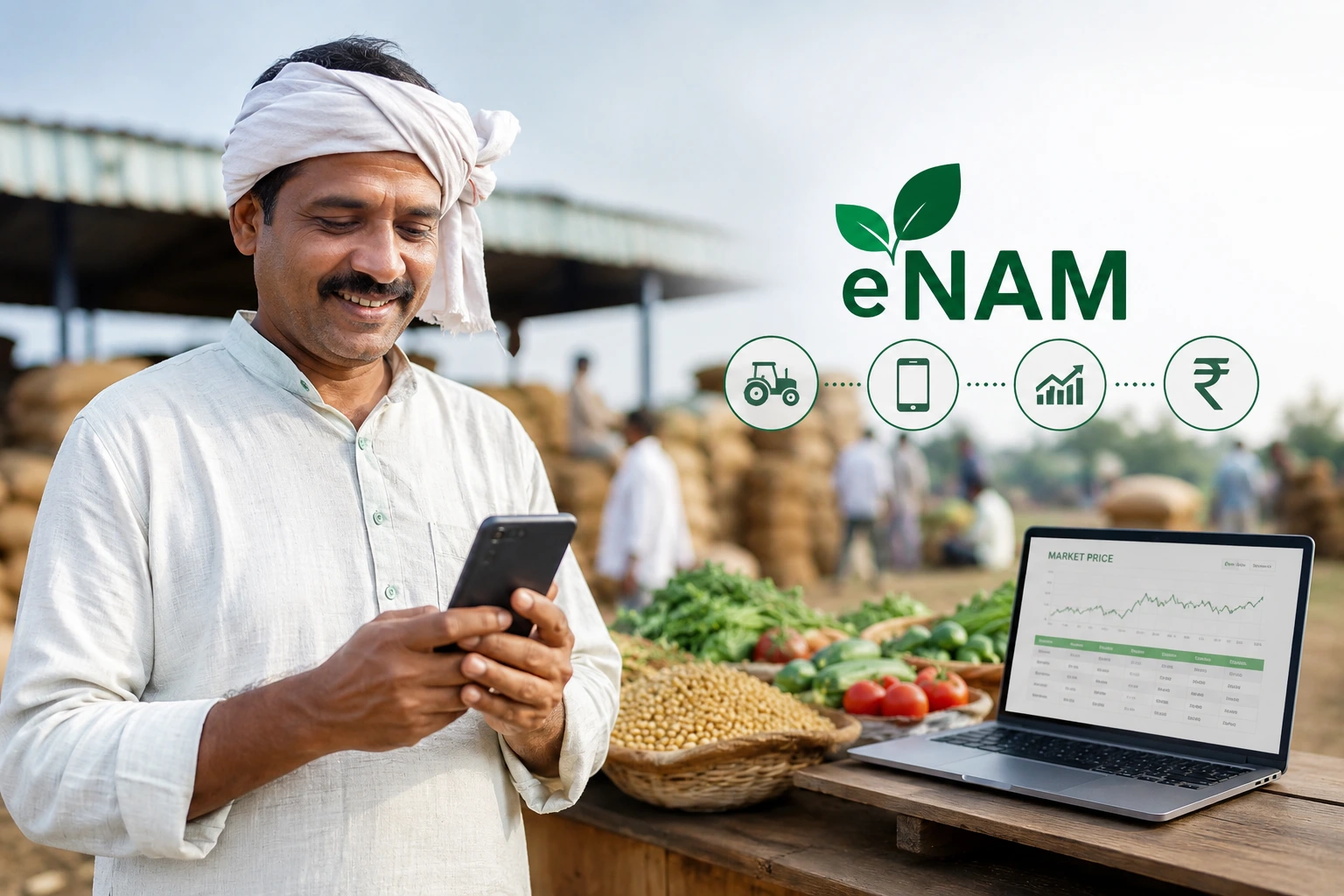
e-NAM: How to Sell Your Crops on India's Online Mandi Platform
Every farmer knows the routine. Load the produce, take it to the local mandi, and hope the traders sitting there that day offer a fair price. If they don't, there isn't much choice. The crop is already harvested, it won't wait, and travelling to another mandi means more transport cost and more time lost.
Now imagine the same crop being seen not just by the traders standing in your mandi, but by buyers sitting in mandis across the state, even in other states. More buyers means more competition for your produce, and more competition usually means a better price.
That is exactly what e-NAM, India's online mandi platform, is built to do. Let's understand what it is, how it works, and how you can start using it.
What is e-NAM?
e-NAM (electronic National Agriculture Market) is a pan-India online trading platform launched by the Government of India in 2016. It is run by the Small Farmers' Agribusiness Consortium (SFAC) under the Ministry of Agriculture & Farmers' Welfare. It aims to connect existing agricultural markets, or APMC mandis, through a common online marketplace.
e-NAM is not a separate, new mandi. It is a digital layer built on top of the mandis (APMCs) that already exist. Your produce still arrives at your local mandi, where it is weighed, tested and graded. The digital platform helps bring more transparency to the trading and bidding process. Instead of depending only on traders physically present at the mandi, eligible buyers connected to the e-NAM network can participate in online bidding for listed produce.
e-NAM at a Glance
- Connects over 1,300 agricultural mandis across multiple Indian states and Union Territories
- Provides a digital marketplace for agricultural commodities
- Enables online bidding and price discovery
- Supports quality-based trading through assaying and grading
- Provides market and commodity price information
- Offers digital services through web and mobile platforms
e-NAM's network, registrations and transaction figures change over time. Check the official e-NAM portal for the latest numbers before publishing specific statistics.
Why is e-NAM Important for Farmers?
In a traditional mandi, the number of buyers available on a particular day may be limited. Fewer buyers can mean less competition for your produce.
e-NAM is designed to widen that market.
With more buyers able to participate, farmers can potentially benefit from:
- More competition: Multiple buyers can bid for the same lot.
- Better price discovery: Prices are determined through competitive bidding rather than a single negotiation.
- Quality-based pricing: Grading and assaying can help buyers assess produce more objectively.
- Greater transparency: Farmers can get better visibility into bids and market prices.
- Wider market access: Eligible traders can participate beyond the farmer's immediate local market.
This makes e-NAM particularly relevant for farmers looking for ways to improve price discovery and reduce dependence on a limited number of local buyers. It also complements other approaches such as selling crops directly without middlemen and direct crop sourcing from farmers.
Farmers already selling at MSP rates for notified crops should note that MSP procurement works differently from e-NAM bidding. MSP guarantees a floor price through designated government agencies, while e-NAM is an open, competitive bidding process. The two aren't mutually exclusive, and which route works best often depends on the crop and mandi.
How Does e-NAM Work?
The process is fairly straightforward once your local mandi is integrated with e-NAM.
1. Take Your Produce to the Mandi
You bring your harvested crop to an e-NAM-connected mandi, just as you normally would. e-NAM works through existing mandis, you don't need to travel anywhere new.
2. Your Produce is Registered
The mandi records produce details such as the crop type, quantity, and quality against your e-NAM farmer ID. The produce is then assigned a lot or transaction identification so it can be tracked from entry to final sale.
3. Quality is Assessed
The produce can be assayed and graded according to applicable quality parameters. This helps buyers evaluate the lot and supports quality-based price discovery.
4. Buyers Bid Online
Once the lot is available for trading, registered buyers and traders across connected mandis can participate in the online bidding process. Bidding usually happens within a set time window on the day of arrival.
5. Bids Are Compared
The bidding process provides a competitive mechanism for determining the price of the lot. All bids are visible in real time through the portal or app, so you know exactly what is being offered and by how much prices are moving.
6. The Sale is Finalised
You choose to accept the highest or most suitable bid. There's no obligation to accept if the price doesn't meet your expectations, depending on your mandi's rules.
7. Direct Payment
Once the sale is confirmed, payment is credited directly to your bank account, rather than being handled in cash or through multiple hands.
In simple terms:
Farm → Mandi → Quality Check → Online Bidding → Sale → Digital Payment
Key Features of e-NAM
Beyond the basic buy-sell process, e-NAM offers a few features that make it genuinely useful for day-to-day decisions:
Live Market Information
Farmers can check real-time commodity prices and market information to make more informed selling decisions.
Online Bidding
The platform facilitates competitive bidding, helping create a more transparent price-discovery mechanism.
Quality-Based Trading
Assaying and grading provide buyers with information about the quality of the produce.
Wider Buyer Access
The platform is designed to connect participating markets and facilitate trade beyond a farmer's immediate local buyer network. Farmers who sell as part of a Farmer Producer Organisation (FPO) can often use this wider reach to negotiate and trade in bulk on behalf of their members, rather than each member selling individually.
Digital Lot Tracking
Every lot has a unique ID. Digital records help track transactions and provide greater visibility throughout the trading process.
Multilingual Access
e-NAM services are available through digital platforms designed to support users across India's diverse linguistic landscape.
Single-Window Service
Gate entry, quality testing, bidding, and payment are all handled on one platform, cutting down repeated paperwork.
Who Can Register for e-NAM?
Farmers can use e-NAM through participating agricultural markets. However, registration and trading procedures can vary depending on the state and mandi.
You may typically need information such as:
- Aadhaar or another accepted identity document
- Mobile number linked to Aadhaar
- Bank account details
- Details related to your agricultural produce
- Land or farmer-related records where requiredMandi/APMC details, where applicable
Before registering, check the requirements applicable to your particular state and mandi.
How to Register on e-NAM
Farmers can generally register through the e-NAM platform or seek assisted registration through participating mandi facilities.
Online Registration
- Visit the official portal at enam.gov.in.
- Select the ‘Farmer Registration’ option.
- Enter the required personal and farmer details.
- Provide the requested bank and other information.
- Upload the required documents (Aadhaar, land records, bank details).
- Submit the registration details for verification.
- Complete any additional verification required by the relevant authorities or mandi.
Your e-NAM ID is usually generated within a few days after verification.
Need Help? Offline Registration
If you are not comfortable completing the process online, ask for assistance at:
- Your local APMC/mandi office
- A participating Common Service Centre (CSC), which many states have set up specifically to help farmers with e-NAM registration
- Your local agriculture department office
- A Krishi Vigyan Kendra (KVK) where relevant
The exact registration process can differ by location, so your local mandi is often the best place to confirm what you need.
What Are the Benefits of e-NAM for Farmers?
The biggest potential benefits are:
- Wider market access: Your crop can potentially be exposed to a broader pool of buyers.
- Competitive price discovery: Online bidding can create greater competition among buyers.
- Transparent trading: Digital records and bidding can make the process easier to track.
- Quality-based pricing: Assaying and grading can help distinguish produce based on quality and help earn a better rate.
- Faster, more reliable payments: Electronic payments can make settlement more convenient where enabled.
- Better market information: Price and arrival information can help farmers make more informed selling decisions.
Is e-NAM Better Than a Traditional Mandi?
It isn't necessarily an either-or choice.
e-NAM works through existing agricultural mandis. You still have to take your produce to the participating mandi, and the actual experience depends heavily on the commodity, local infrastructure, number of active buyers and how actively that mandi uses the platform.
For some farmers and commodities, online bidding can improve competition and transparency. In other cases, the benefits may be more limited if buyer participation is low.
That's why it is worth asking your local mandi how actively e-NAM is being used for your particular crop before relying on it as your primary selling route.
Things Farmers Should Know Before Using e-NAM
e-NAM can make agricultural trading more transparent, but it does not eliminate every challenge.
- You still need to transport your crop to the mandi. e-NAM digitises the sale process, not the transport.
- Bidding activity varies by mandi and commodity. Some mandis and crops see very active bidding; others may have fewer buyers online for a particular commodity. It's worth checking activity for your specific crop and mandi.
- Quality and grading can affect the final price.
- Registration requirements may vary by state and mandi.
- The platform improves the trading process, but it does not guarantee a particular selling price.
- Not every mandi in every state is equally active on the platform yet, even where e-NAM is technically available. Ask locally about how well-used it is in your area.
So, before taking your produce to a mandi, compare available market prices and understand how active e-NAM trading is for your crop.
How Khetavya Can Help Farmers Sell Their Crops
Government platforms like e-NAM can create new opportunities, but understanding registration, mandi procedures, buyer options and current market conditions can still be challenging.
That's where our Crop Selling Support can help.
Khetavya supports farmers in navigating the crop-selling process, understanding available market opportunities, connecting with suitable buyers and making more informed selling decisions.
The goal is simple: help farmers spend less time figuring out the selling process and more time focusing on their farms.