
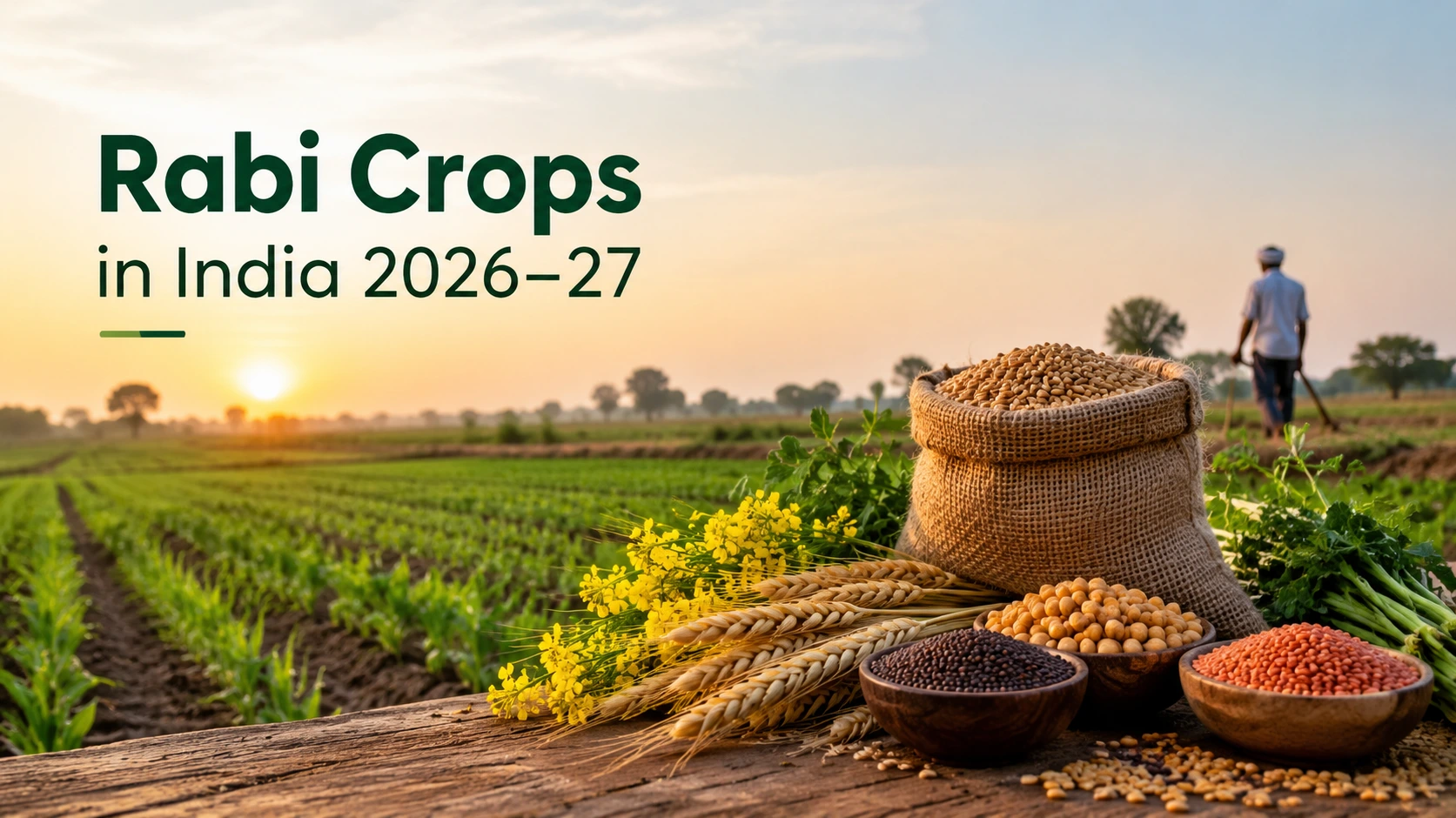
Rabi Crops in India 2026-27: Sowing Time, New MSP & Best Crops
Rabi sowing for 2026–27 is beginning across India, and the government has announced new Minimum Support Prices (MSP) for the 2027–28 marketing season.
The new MSPs are especially important this year because the 2026 monsoon ended 12.6% below normal, increasing the importance of choosing crops according to available water and soil conditions.
This guide covers the latest Rabi MSP rates, sowing times, seed requirements, irrigation needs, state-wise crop choices and tips for selecting the right Rabi crop.
What are Rabi Crops?
Rabi crops are generally sown from October to December and harvested between February and April, depending on the crop, region and weather.
Major Rabi crops in India include:
- Wheat
- Mustard
- Gram (chana)
- Lentil (masur)
- Barley
- Safflower
For the 2027–28 Rabi Marketing Season, the government has increased MSP for all six mandated Rabi crops.
The new MSP is ₹2,610/quintal for wheat, ₹6,613 for mustard, ₹5,958 for gram and ₹7,390 for lentil.
Why do some websites show wheat MSP as ₹2,585 while others show ₹2,610?
The difference is because MSP is linked to the marketing season, not the sowing year.
Crops sown during late 2026 will generally be sold during Rabi Marketing Season (RMS) 2027–28. Therefore, the new wheat MSP is ₹2,610 per quintal, while ₹2,585 was the MSP for RMS 2026–27.
New Rabi MSP 2027–28
Rabi Crop |
MSP 2026–27 |
New MSP 2027–28 |
Increase |
|---|---|---|---|
| Wheat | ₹2,585 | ₹2,610 | ₹25 (0.97%) |
| Barley | ₹2,150 | ₹2,286 | ₹136 (6.33%) |
| Gram | ₹5,875 | ₹5,958 | ₹83 (1.41%) |
| Lentil (Masur) | ₹7,000 | ₹7,390 | ₹390 (5.57%) |
| Mustard | ₹6,200 | ₹6,613 | ₹413 (6.66%) |
| Safflower | ₹6,540 | ₹7,215 | ₹675 (10.32%) |
The largest increase is for safflower at ₹675 per quintal, followed by mustard at ₹413 and lentil at ₹390. Wheat received the smallest increase, at ₹25 per quintal.
The stronger increases for oilseeds and pulses are consistent with the government's broader push to increase domestic production and reduce dependence on imports.
For more information, see our MSP crop list and how to sell crops
Rabi Crop Sowing Time, Seed Rate & Water Requirement
The exact sowing window varies by variety, state, temperature and soil moisture. The following are general planning ranges.
Crop |
Typical Sowing Window |
Approx. Seed/Acre |
Irrigation Need* |
|---|---|---|---|
| Mustard | October | 1.5–2 kg | 2–3 |
| Safflower | Late Sept–Oct | 6–8 kg | 0–1 |
| Gram | Mid-Oct–Mid-Nov | 25–30 kg | 1–2 |
| Lentil | Late Oct–Late Nov | 12–18 kg | 1–2 |
| Wheat | November | ~40 kg | 4–6 |
| Barley | November | ~40 kg | 2–3 |
*Indicative only. Actual irrigation requirements depend on soil, rainfall, variety and farming practices.
Timely sowing matters. For example, wheat sown too late can face higher temperatures during grain filling, while delayed mustard sowing can affect yield and pest management.
Farmers should follow recommendations from their local Krishi Vigyan Kendra (KVK) or state agriculture department for the selected variety.
State-Wise Rabi Sowing Guide
State |
Main Rabi Crops |
Typical Sowing Period |
|---|---|---|
| Punjab & Haryana | Wheat, mustard, potato | Wheat: late Oct to mid Nov. Mustard: Oct |
| Uttar Pradesh | Wheat, potato, lentil, gram | Wheat: 1-25 Nov. Lentil: late Oct to mid Nov |
| Madhya Pradesh | Wheat, gram, lentil | Gram: mid Oct to mid Nov. Wheat: 1-25 Nov |
| Rajasthan | Mustard, wheat, gram, cumin | Mustard: 1-25 Oct. Wheat: 1-25 Nov |
| Gujarat | Wheat, gram, cumin, mustard | Gram: late Oct to mid Nov. Wheat: 5-25 Nov. Cumin: 1-25 Nov |
| Maharashtra | Gram, wheat, Rabi jowar, safflower | Safflower: end Sept to mid Oct. Gram: Oct to mid Nov |
| Bihar | Wheat, lentil, mustard | Lentil: late Oct to 20 Nov. Wheat: 10-30 Nov |
These are broad windows, not fixed dates. Farmers should adjust sowing according to local weather, soil moisture and recommended varieties.
Which Rabi Crop Should You Choose?
Start with water availability, then check your soil.
If you have assured irrigation:
Wheat can be considered where adequate irrigation and suitable soil are available. Mustard can also be an option where conditions are suitable.
If you have limited irrigation:
Consider mustard, gram, lentil or barley. These crops generally require less irrigation than a fully irrigated wheat crop.
If you mainly depend on residual soil moisture:
Gram and safflower can be suitable in areas and soils where they are locally recommended. Safflower is particularly associated with rainfed Rabi farming in parts of Maharashtra and Karnataka.
If your soil has salinity problems:
Barley and mustard can be more tolerant of saline conditions than some other Rabi crops. However, soil testing should guide the final crop choice.
Not sure about your soil? Start with a soil test before sowing and learn about the Soil Health Card scheme.
Which Rabi Crop Can Give Better Returns?
MSP alone does not determine profit. Your yield, input cost, irrigation cost, labour, market price and selling method all affect the final return.
For example, using the assumed yields below, the gross value at the new MSP would be:
- Mustard: 8 quintals × ₹6,613 = ₹52,904
- Wheat: 18 quintals × ₹2,610 = ₹46,980
- Lentil: 6 quintals × ₹7,390 = ₹44,340
- Gram: 7 quintals × ₹5,958 = ₹41,706
These are gross values before cultivation costs, not guaranteed profits.
This is why a crop with a higher MSP may not necessarily be the most profitable option for your farm.
Read more about reducing farming costs.
How the Weak 2026 Monsoon Could Affect Rabi Farming
India's 2026 southwest monsoon ended 12.6% below normal, making it the weakest monsoon since 2015 and one of the lowest in recent decades.
This makes water management especially important for Rabi farmers.
4 practical steps:
- Choose crops according to available irrigation. Don't select a water-intensive crop simply because its MSP is higher.
- Sow into adequate soil moisture and avoid unnecessary early irrigation.
- Use efficient irrigation methods such as sprinkler or drip where suitable.
- Retain suitable crop residue or mulch where recommended to reduce moisture loss.
Buy Certified Seeds and Fertilizers Early
Use certified seed and region-appropriate varieties recommended for your crop and sowing period.
Before purchasing:
- Check the seed label and certification details.
- Verify the fertilizer's packaging and MRP.
- Avoid suspiciously cheap products.
- Purchase from authorized dealers where possible.
Learn how to identify fake seeds and fertilizers.
Buying inputs early can also help farmers avoid last-minute shortages during peak sowing.
How to Sell Rabi Crops at the Best Price
MSP is a government-announced benchmark, but procurement arrangements vary by crop and state. Farmers should check their state's procurement process before harvest.
A practical approach is:
- Register with the relevant state procurement system if you plan to sell through MSP procurement.
- Keep land, identity and bank documents ready.
- Compare mandi prices before selling.
- Check available market information through e-NAM and online mandi platforms.
- Consider joining an FPO to improve access to markets and bargaining opportunities. See how to join an FPO.
Farmers can also explore PMFBY crop insurance and Kisan Credit Card financing.
Make the Right Crop Choice for Rabi Season
For Rabi 2026–27, don't choose a crop based on MSP alone.
Start by checking:
- Water availability → Soil condition → Sowing window → Expected yield → Input cost → Local market/procurement
With the 2026 monsoon ending below normal and higher MSP increases for crops such as safflower, mustard and lentil, careful crop planning can make a real difference. Check your soil, use quality inputs, sow at the right time and explore available government support.
Khetavya helps farmers make better-informed decisions with practical information on crops, farming costs, government schemes, markets, technology and modern agricultural practices.