
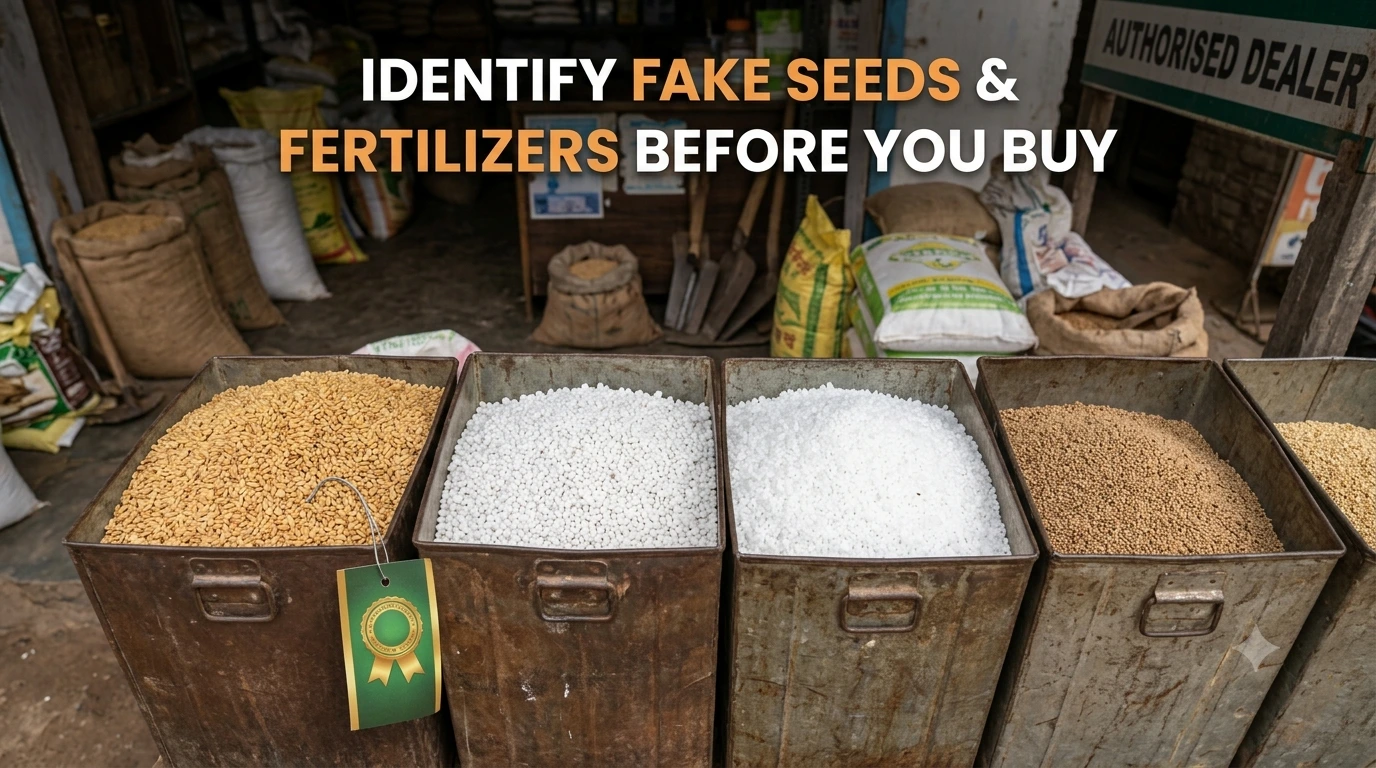
How to Identify Fake Seeds & Fertilizers Before You Buy: Farmer's Safety Guide
A season’s income can depend on what’s inside a single bag of seeds or fertilizer. From the outside, genuine and counterfeit products may look almost identical. The difference may only become visible weeks or months later through poor germination, weak plant growth, or low crop yields, when it is too late to recover the investment.
Fake, adulterated, or substandard agricultural inputs can cause significant losses, particularly during peak sowing seasons when demand is high. The good news is that farmers can take several simple precautions to reduce the risk before buying or sowing.
Here’s a practical guide to help you identify suspicious seeds and fertilizers and protect your crop investment.
Why Fake Agricultural Inputs Enter the Market
During sowing seasons, shortages and high demand can create opportunities for counterfeit or substandard products to enter local markets. Unauthorised sellers may repackage products, misrepresent varieties, or sell inputs that don't meet required quality standards.
Because farmers may not have access to testing facilities at the time of purchase, checking the packaging, documentation, seller credentials, and product details becomes especially important.
How to Identify Fake or Substandard Seeds
1. Check the Certification Tag
Look carefully at the seed bag for the appropriate certification or quality tag. Certified seeds generally carry a prescribed tag indicating their certification status and other details. For example, green for certified seed and golden yellow for foundation seed.
A missing, damaged, suspicious, or poorly printed tag should be treated as a warning sign. Don't rely on the tag alone, check the other information on the package as well.
2. Examine the Printed Details
Before paying, check the information printed on the package, including:
- Crop and variety name
- Lot or batch number
- Date of testing/packing or other required dates
- Germination percentage
- Purity information, where applicable
- Net weight
- Name and address of the producer or company
Be cautious if information is missing, smudged, overwritten, covered with another label, or appears to have been altered.
3. Check the Dealer's Licence
Buy seeds only from an authorised seed dealer. Ask the seller for their valid licence or registration details where applicable.
If a seller refuses to provide basic credentials or cannot explain where the seeds came from, consider buying elsewhere.
4. Inspect the Packaging
Look closely at the bag or packet before purchasing.
Watch for:
- Broken or loose stitching
- Signs of resealing
- Damaged labels
- Poor-quality printing
- Spelling mistakes
- Packaging that appears reused
- Mismatched batch or lot information
Genuine products should have consistent, professionally printed packaging and traceable product information.
5. Verify the Variety
Make sure the variety printed on the packet is the variety you intended to purchase. Where possible, verify that the variety is recommended or approved for your crop and region through your local agriculture department, Krishi Vigyan Kendra (KVK), or other official agricultural sources.
6. Consider a Germination Test
If you are uncertain about seed quality, a small germination test can provide an early indication of viability.
Take a representative sample and test it under suitable conditions before committing the entire field. A simple test cannot replace official laboratory testing, but a clearly poor result is a reason to stop and investigate further.
How to Identify Fake or Adulterated Fertilizers
1. Check the Packaging and Regulatory Details
Fertilizers sold in India are regulated under the Fertilizer (Control) Order (FCO). Check the package for the required product information, manufacturer details, nutrient content, batch details, net weight, and other applicable markings.
Don't purchase fertilizer simply because the bag resembles a familiar brand.
2. Check the Weight
Compare the actual weight with the net weight printed on the package. If you have access to a reliable weighing scale, checking the bag can help identify underweight or tampered products.
3. Examine the Granules
Pay attention to the product's appearance. Depending on the fertilizer, genuine material generally has characteristic physical properties such as granule size, colour, and texture.
Unusual variation, excessive dust, moisture, lumps, or material that looks significantly different from what you normally purchase may justify further checking.
However, appearance alone cannot confirm whether a fertilizer is genuine. Different formulations can naturally vary in colour and physical appearance.
4. Be Careful with Home Testing
You may find advice online recommending simple tests such as dissolving urea in water or heating DAP with lime. These tests can sometimes reveal obvious differences, but they cannot reliably establish fertilizer quality or authenticity.
For example, the fact that a product dissolves or produces a particular smell does not by itself prove that it meets the required nutrient specifications.
If you seriously suspect adulteration, preserve a sample and request official laboratory testing through the appropriate agriculture or fertilizer quality-control authority.
5. Always Ask for a Proper Bill
A bill or cash memo is important evidence of where and when you purchased the product.
Before leaving the shop, make sure the bill identifies the product and purchase details. Keep it safely along with the original packaging, tag, and batch number.
6 Practical Ways to Buy Agricultural Inputs Safely
Before purchasing seeds or fertilizers, farmers should also consider soil testing before sowing to understand their field’s nutrient requirements and choose inputs accordingly.
- Buy from authorised dealers and established agricultural suppliers.
- Check the packaging and batch/lot information before paying.
- Ask for a proper bill for every purchase, even for smaller quantities.
- Be cautious of unusually low prices, especially when the seller is unknown.
- Avoid unlabelled or loosely packaged products whose source cannot be verified.
- Keep the packaging, tags, batch numbers, and bills until the crop season is complete.
A few minutes spent checking an agricultural input can help protect an entire season's investment.
What to Do If You Suspect a Fake Input
If you have already purchased seeds or fertilizer and suspect that the product is fake, adulterated, or substandard:
1. Stop and Preserve the Product
Don't throw away the remaining seeds, fertilizer, packaging, tags, or labels. Keep a representative portion safely stored.
2. Keep Your Purchase Evidence
Preserve your bill, receipt, photographs of the package, batch or lot number, and details of the seller.
3. Report the Issue
Contact your local Seed Inspector, Agriculture Officer, Fertilizer Inspector, or relevant state agriculture department and explain your concern.
4. Ask About Official Testing
Where appropriate, request information about submitting a sample to an authorised seed testing or fertilizer quality-control laboratory. Official testing is much more reliable than relying solely on household tests or appearance.
5. Ask About Your Legal Options
Indian laws and regulations provide mechanisms for regulating agricultural inputs and taking action against violations. The appropriate remedy can depend on the product, evidence, jurisdiction, and circumstances.
How Khetavya Helps Farmers Buy Input With Confidence
This is the risk that Khetavya’s Input Supply service is designed to help address.
Instead of leaving farmers to navigate an unfamiliar dealer network, Khetavya sources seeds, fertilizers, and other agricultural inputs through verified manufacturers and suppliers, with quality checks before dispatch.
The goal is simple: make it easier for farmers to access reliable agricultural inputs without having to guess whether the product they are buying is genuine.
Check Before You Buy, Protect Before You Sow
Fake seeds and fertilizers rarely look obviously fake. That's why checking before purchase is so important.
- Look at the certification and packaging.
- Verify product and dealer details.
- Insist on a bill.
- Keep the original bag and batch information.
If something seems suspicious, don't rely on appearance or informal home tests alone, seek help from the agriculture department and use official testing where appropriate.
A few minutes of checking at the point of purchase can help protect months of work and an entire season's investment.