
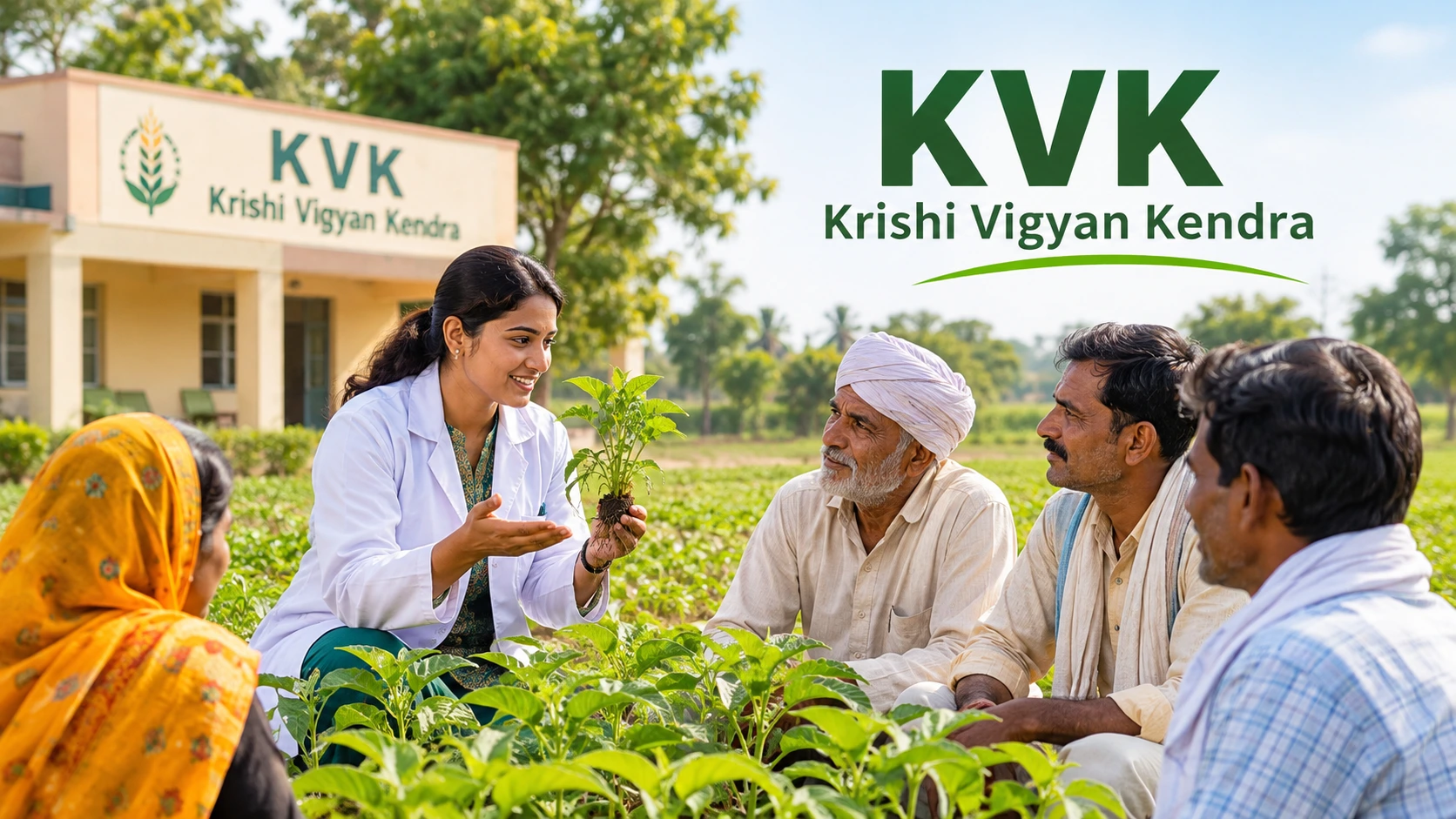
What is a KVK? Services, Free Training and Benefits for Farmers
Farmers regularly face decisions that can affect an entire harvest.
- Which crop variety is best suited to local soil conditions?
- How should a new pest infestation be controlled?
- Is a particular farming technique worth the investment?
- And where can farmers get reliable agricultural advice without depending on product sellers?
One valuable resource is often closer than farmers realise: the Krishi Vigyan Kendra (KVK), or Farm Science Centre.
Established under the Indian Council of Agricultural Research (ICAR), KVKs connect agricultural research with practical farming. They help farmers learn about improved cultivation techniques, manage pests and diseases, understand soil health and explore new income opportunities.
Whether you are a small farmer, an FPO member or someone interested in starting an agricultural business, this guide explains what KVKs do, which services they offer and how you can benefit from your nearest centre.
What is a Krishi Vigyan Kendra (KVK)?
A Krishi Vigyan Kendra is a district-level agricultural extension centre established to transfer scientific knowledge and modern farming technologies directly to farmers.
The concept was introduced by ICAR, with the first KVK established in 1974 at Puducherry. Since then, the network has expanded across India. According to information provided by the Government of India to Parliament in November 2024, the country had 731 KVKs.
The primary objective of a KVK is to make agricultural research useful in real farming conditions.
Its official mandate focuses on three key activities:
- Technology Assessment: Testing agricultural technologies to determine whether they are suitable for local farming conditions.
- Technology Demonstration: Showing farmers how improved technologies and practices work in actual fields.
- Capacity Development: Training farmers, farm women and rural youth to adopt better agricultural practices.
In simple terms, a KVK helps farmers understand what works, how to implement it and how to improve farm productivity.
Who Runs KVKs in India?
KVKs operate under the ICAR network but are hosted by different agricultural and educational institutions.
These include:
Host Institution |
Approx. Number of KVKs |
|---|---|
| State Agricultural Universities | 506 |
| Non-Governmental Organisations (NGOs) | 103 |
| ICAR institutes | 66 |
| State Governments | 38 |
| Others (central universities, PSUs, other institutions) | Remaining centres |
At the regional level, 11 Agricultural Technology Application Research Institutes (ATARIs) coordinate, monitor and support KVK activities.
Each KVK has a team of agricultural specialists covering areas such as crop production, plant protection, soil science, horticulture, animal science and home science.
Many centres also maintain demonstration farms where farmers can observe new agricultural technologies and practices.
What Services Does a KVK Provide to Farmers?
KVKs offer several services to improve agricultural productivity, reduce farming challenges and encourage rural entrepreneurship. Although the facilities differ between centres, the following are among their major activities.
1. Free or Low-Cost Agricultural Training
One of the most useful KVK services is practical training for farmers, farm women and rural youth.
Training programmes cover topics such as:
- Improved crop cultivation and farm management.
- Organic and natural farming practices.
- Mushroom cultivation and beekeeping.
- Dairy farming, poultry and animal husbandry.
- Horticulture and vegetable production.
- Food processing and agricultural entrepreneurship.
Programmes may last a few hours or several days, depending on the subject. Many are free, while some may involve nominal charges for materials or other facilities.
Farmers can contact their nearest KVK to check upcoming training sessions and registration requirements.
2. On-Farm Testing (OFT)
Not every agricultural technology works equally well in every region. Soil type, rainfall, temperature and local farming practices can influence results.
Through On-Farm Testing, KVK scientists evaluate new technologies under actual farming conditions.
For example, a KVK may test different crop varieties, fertilizer combinations or pest management techniques to identify which options perform best locally.
This helps farmers make more informed decisions before adopting a new practice on a larger scale.
3. Frontline Demonstrations (FLDs)
Frontline Demonstrations allow farmers to see the results of improved agricultural technologies in practice.
KVKs organise demonstration plots on farmers' fields or their own farms to showcase:
- High-yielding and improved crop varieties.
- Better sowing and planting methods.Integrated pest and disease management.
- Efficient fertilizer and water management.
- Improved farm machinery and equipment.
Farmers can compare traditional practices with recommended methods and understand their potential benefits before making changes.
4. Soil Testing and Fertilizer Recommendations
Healthy soil is essential for sustainable farming. Applying fertilizers without understanding soil requirements can increase cultivation costs and affect long-term soil health.
Many KVKs provide soil-related guidance, including:
- Assistance with soil sample collection.
- Soil test report interpretation.
- Fertilizer and nutrient management recommendations.
- Guidance on soil health improvement.
- Advice on composting and organic inputs.
Farmers who already have a Soil Health Card can approach their KVK to understand the results and make suitable fertilizer decisions.
5. Crop Advisories and Pest Management
Unexpected pest attacks, plant diseases and changing weather conditions can significantly affect crop production.
KVKs help farmers identify agricultural problems and receive timely technical advice.
Their support may include:
- Identifying crop pests and diseases.
- Recommending suitable management practices.
- Sharing weather-based agricultural advisories.
- Providing information on integrated pest management.
- Issuing seasonal and crop-stage-specific alerts.
Some centres also share updates through SMS, WhatsApp groups and mobile-based communication channels.
6. Seeds, Saplings and Bio-Inputs
Several KVKs produce or distribute agricultural planting material and useful farm inputs.
Depending on the centre, farmers may be able to obtain:
- Quality seeds of selected crop varieties.
- Vegetable seedlings and horticultural saplings.
- Fruit plants and nursery material.
- Biofertilizers and biopesticides.
- Beneficial bio-agents for pest management.
Availability, pricing and distribution schedules vary, so farmers should contact the centre before visiting.
7. Agricultural Awareness Programmes and Field Visits
KVKs regularly organise activities that bring farmers, scientists and agricultural experts together.
These may include:
- Farmers' fairs and agricultural exhibitions.
- Kisan Goshthis (farmer-scientist interactions).
- Field days and demonstration visits.
- Exposure visits to successful farms.
- Awareness campaigns about government agricultural schemes.
These activities help farmers learn from experts as well as from other farmers.
8. Support for Agricultural Entrepreneurship
KVKs also encourage farmers and rural youth to explore income opportunities beyond traditional crop cultivation.
Depending on local expertise and facilities, they may provide technical training in mushroom production, food processing, beekeeping, dairy farming, seed production and other agriculture-based enterprises.
This can help farmers diversify their income and develop small rural businesses.
How to Find and Contact Your Nearest KVK
Finding your district's KVK is relatively straightforward.
Farmers can use the following resources:
1. ICAR KVK Portal
Visit the official ICAR Krishi Vigyan Kendra portal to find information about KVKs, their activities and available resources.
2. ATARI Regional Websites
India has 11 ATARIs that oversee KVK activities across different regions. Their websites can help farmers locate centres and access regional agricultural information.
3. KVK Contact Directory
ICAR publishes KVK directories containing centre details and contact information. These can help farmers identify the appropriate centre.
4. Local Agriculture Department
Farmers can also contact their district agriculture office, agricultural university or nearby Farmer Producer Organisation (FPO) for information about the nearest KVK.
What Should You Carry When Visiting a KVK?
To help agricultural scientists understand your requirements, carry relevant farming information when visiting the centre.
Here are some useful items:
- Aadhaar card and a working mobile number, if required for registration.
- Land records or survey number, if relevant.
- Soil Health Card or recent soil test report.
- A sample of the affected plant, leaf or crop, if reporting a pest or disease.
- Details of the crop, variety and sowing date.
- Information about fertilizers, pesticides and other inputs already used.
Providing accurate information helps scientists offer more relevant recommendations.
Ways to Get the Most Out of Your KVK
Simply visiting a KVK once may not be enough. Building a regular connection with the centre can help farmers access more opportunities.
- Visit before the cropping season: Ask about upcoming training programmes, recommended varieties and seasonal crop advisories.
- Join WhatsApp or SMS groups: Stay informed about weather updates, pest alerts and agricultural events.
- Attend field demonstrations: Observe new farming methods before investing money in them.
- Visit as a farmer group: Coordinate with neighbouring farmers or your FPO to request group training.
- Connect with subject experts: Identify the scientist responsible for your crop or farming activity and seek relevant guidance.
- Share feedback: Inform KVK scientists about the results of technologies you have adopted. Your experience can help improve future recommendations.
How Can FPOs Benefit from KVKs?
Krishi Vigyan Kendras can be valuable technical partners for Farmer Producer Organisations.
FPOs can approach their district KVK to explore opportunities such as:
- Group training for member farmers.
- Crop planning and improved cultivation practices.
- Soil health and nutrient management awareness.
- Post-harvest handling and quality improvement.
- Food processing and value-addition training.
- Technical guidance for agriculture-based business activities.
For example, an FPO working with vegetable growers could approach its KVK for training on improved cultivation, grading, storage and post-harvest management.
FPO representatives can contact the KVK directly to discuss their members' requirements and explore suitable training or demonstration programmes.
Your Nearest KVK: A Valuable Partner in Farming
Krishi Vigyan Kendras are an important link between agricultural research and everyday farming. They give farmers access to scientific guidance, practical demonstrations, training and technical support, often free of charge or at nominal costs.
From improving soil health and managing crop diseases to exploring mushroom cultivation or food processing, KVKs can help farmers make better-informed decisions.
However, the real benefit comes from using these centres regularly rather than approaching them only when problems arise.
Start by finding your nearest KVK through the official ICAR portal. Contact the centre, ask about upcoming training programmes and demonstrations, and explore how its agricultural experts can support your next cropping season.