
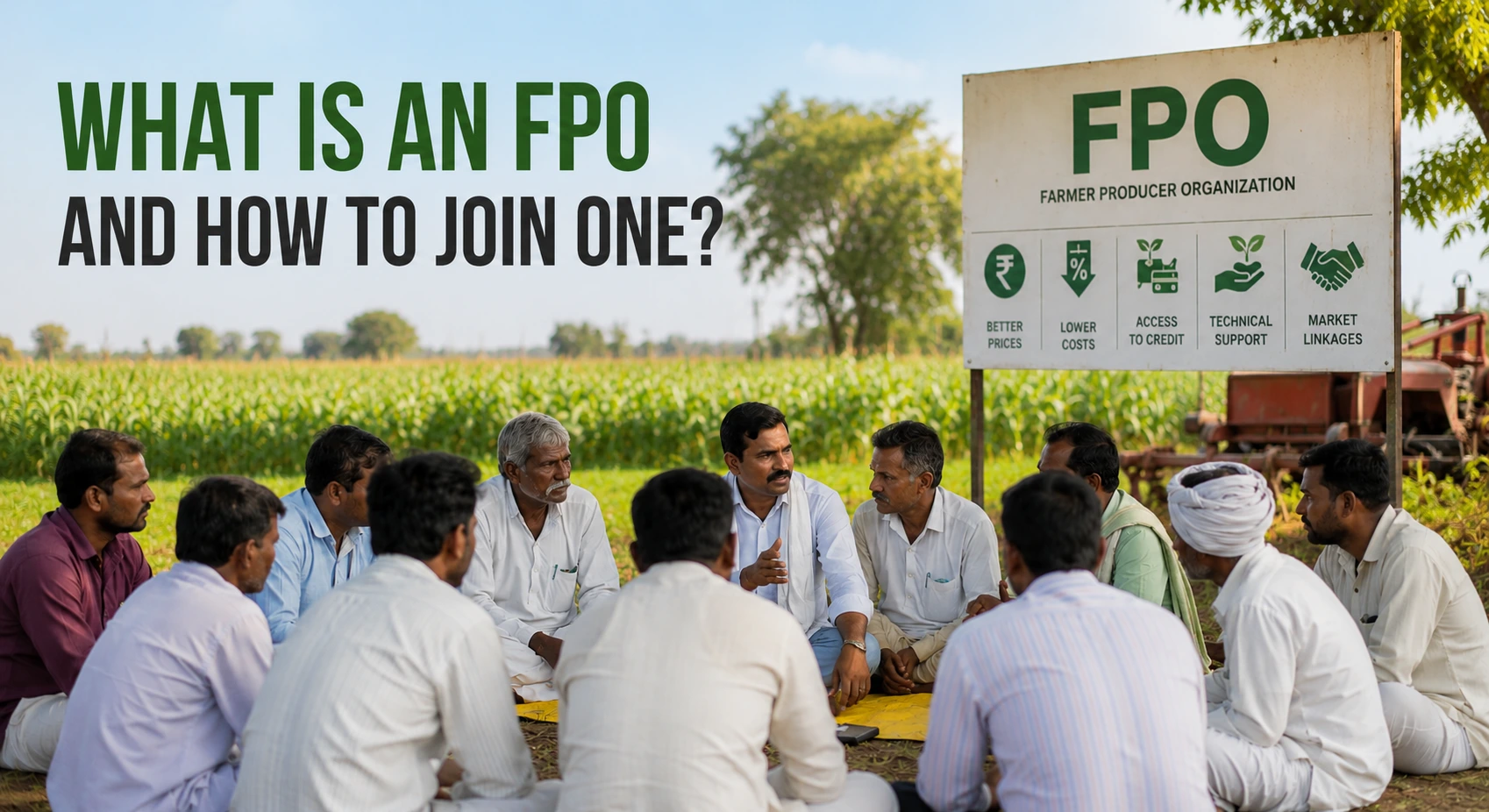
What is an FPO and How to Join One? Guide for Indian Farmers
If you're an Indian farmer, you've probably heard the term FPO in government announcements, at your local mandi, or from fellow farmers. But what exactly is an FPO, and why are so many farmers choosing to become members?
The answer is simple: an FPO helps farmers work together, reduce costs, and earn better prices for their produce.
Let's understand it simply.
What is an FPO?
FPO stands for Farmer Producer Organization. It is a legally registered organization formed by a group of farmers who come together to improve their collective bargaining power, reduce farming costs, and access larger markets.
Instead of every farmer operating independently, an FPO allows members to function as one organized business entity.
Imagine this:
As an individual farmer, you may pay higher prices for seeds, fertilizers, or machinery and often have little negotiating power while selling your crops. But when hundreds of farmers pool their resources through an FPO, they can:
- Purchase agricultural inputs in bulk at lower prices
- Share expensive farm machinery and equipment
- Access institutional credit more easily
- Sell produce directly to processors, retailers, exporters, or large buyers
- Reduce dependence on multiple intermediaries
Most FPOs are registered as Producer Companies under the Companies Act, 2013, although some operate as cooperative societies. They are managed by a Board of Directors elected from among the member farmers, ensuring that decisions remain farmer-led.
Why is the Government Promoting Farmer Producer Organizations?
Recognizing the challenges faced by small and marginal farmers, the Government of India launched the Central Sector Scheme in 2020 for Formation and Promotion of 10,000 Farmer Producer Organizations with support from NABARD, SFAC (Small Farmers' Agribusiness Consortium), and NCDC.
The objective is to help farmers achieve economies of scale, improve market access, and increase farm incomes.
Under this initiative, eligible FPOs receive support such as:
- Financial assistance of up to ₹18 lakh over three years for management and operational expenses
- Matching Equity Grant of up to ₹15 lakh to strengthen the FPO's capital base
- Credit Guarantee Cover of up to ₹2 crore to facilitate collateral-free institutional loans
- Assistance with licenses, certifications, branding, market linkages, and business development
With over 85% of Indian farmers classified as small and marginal landholders, FPOs provide a practical way to overcome the limitations of farming individually.
Benefits of Joining an FPO
1. Better Prices for Your Produce
FPOs aggregate produce from multiple farmers and sell in bulk directly to processors, retailers, exporters, and institutional buyers. This often results in better price realization by reducing dependence on commission agents and multiple intermediaries.
2. Lower Cost of Agricultural Inputs
Seeds, fertilizers, pesticides, and other farm inputs are purchased in bulk, allowing members to benefit from wholesale pricing.
Many farmers save 10–15% or more on input costs compared to buying individually.
3. Access to Farm Machinery
Purchasing tractors, harvesters, planters, or sprayers individually is often expensive for small farmers.
Many FPOs establish shared machinery banks or work alongside Custom Hiring Centers, allowing members to rent machinery and equipment at affordable rates.
4. Easier Access to Credit
Banks and financial institutions are generally more comfortable lending to registered organizations than individual farmers without collateral.
As a result, FPOs often help members access:
- Crop loans
- Working capital
- Farm expansion finance
- Government-backed credit schemes
5. Stronger Bargaining Power
Whether negotiating with buyers, participating in contract farming, or entering long-term supply agreements, an organized group of farmers commands significantly more negotiating power than an individual seller.
6. Training and Technical Support
Many FPOs regularly organize:
- Soil testing programs
- Crop advisory services
- Farmer training workshops
- Exposure visits
- Demonstrations of modern farming techniques
These initiatives help members improve productivity and adopt better farming practices.
7. Storage and Post-Harvest Support
Several FPOs invest in infrastructure such as:
- Warehouses
- Cold storage facilities
- Collection centers
- Grading and sorting units
This helps reduce post-harvest losses and allows farmers to avoid distress selling immediately after harvest.
How to Join an FPO
Step 1: Find an FPO in Your Area
Many districts across India already have active FPOs.
You can locate one by contacting:
- Your local Krishi Vigyan Kendra (KVK)
- District Agriculture Office
- NABARD regional office
- SFAC's online FPO directory
Step 2: Check the Eligibility Criteria
While requirements vary slightly between FPOs, you will generally need to:
- Be an active farmer cultivating or owning agricultural land within the FPO's operational area
- Purchase a small number of equity shares (commonly between ₹500 and ₹1,000 per share, depending on the FPO)
- Agree to follow the FPO’s bylaws and actively participate in its activities
Step 3: Apply for Membership
The application process is usually straightforward. You'll typically need to:
- Fill out a membership application form with the FPO
- Submit basic KYC documents such as Aadhaar Card, land ownership or cultivation records (such as a 7/12 extract where applicable), bank account details or passbook
- Purchase the required equity shares
Once approved by the Board of Directors, you officially become a member.
Step 4: Start Participating
As a member, you can immediately begin benefiting from the FPO's services, including:
- Purchasing farm inputs
- Selling produce collectively
- Accessing machinery
- Participating in training programs
- Availing financial services
- Voting in member meetings
- Contesting Board elections (subject to the FPO's rules)
What if There Isn't an FPO in Your Area?
If your village or district doesn't already have one, you can help establish a new FPO. Typically, a group of farmers can approach a Producer Organization Promoting Institution (POPI) such as an NGO, cooperative, or agency supported by SFAC, NABARD, or NCDC.
The POPI assists with:
- Farmer mobilization
- Registration
- Legal compliance
- Governance
- Capacity building
- Business planning
- Operational support during the initial years
While many successful FPOs eventually have 100 or more farmer members, the minimum number required during formation may vary depending on the registration model and state-specific regulations.
Things to Check Before Joining an FPO
Not every FPO operates with the same level of efficiency or transparency.
Before becoming a member, consider asking:
- How long has the FPO been operating?
- Does it regularly conduct member meetings?
- Are financial records transparent?
- Has it consistently helped farmers secure better prices?
- Does it have established buyers and market linkages?
- What services are currently available to members?
Speaking with existing members is one of the best ways to evaluate an FPO's performance.
FPOs: Strengthening Small Farmers Through Collective Growth
For small and marginal farmers, joining an FPO can be one of the most effective ways to improve profitability, reduce production costs, and gain access to larger markets. By working collectively, farmers can achieve the scale needed to negotiate better prices, adopt modern farming practices, and strengthen their long-term financial stability.
As government support, institutional financing, and market linkages continue to expand, FPOs are becoming an increasingly important part of India's agricultural ecosystem.
If your FPO is looking to connect with reliable buyers, improve crop procurement, streamline logistics, or access agricultural machinery, Khetavya works closely with FPOs to bridge the gap between farmers and markets, helping producer organizations unlock better opportunities and maximize value for their members.