
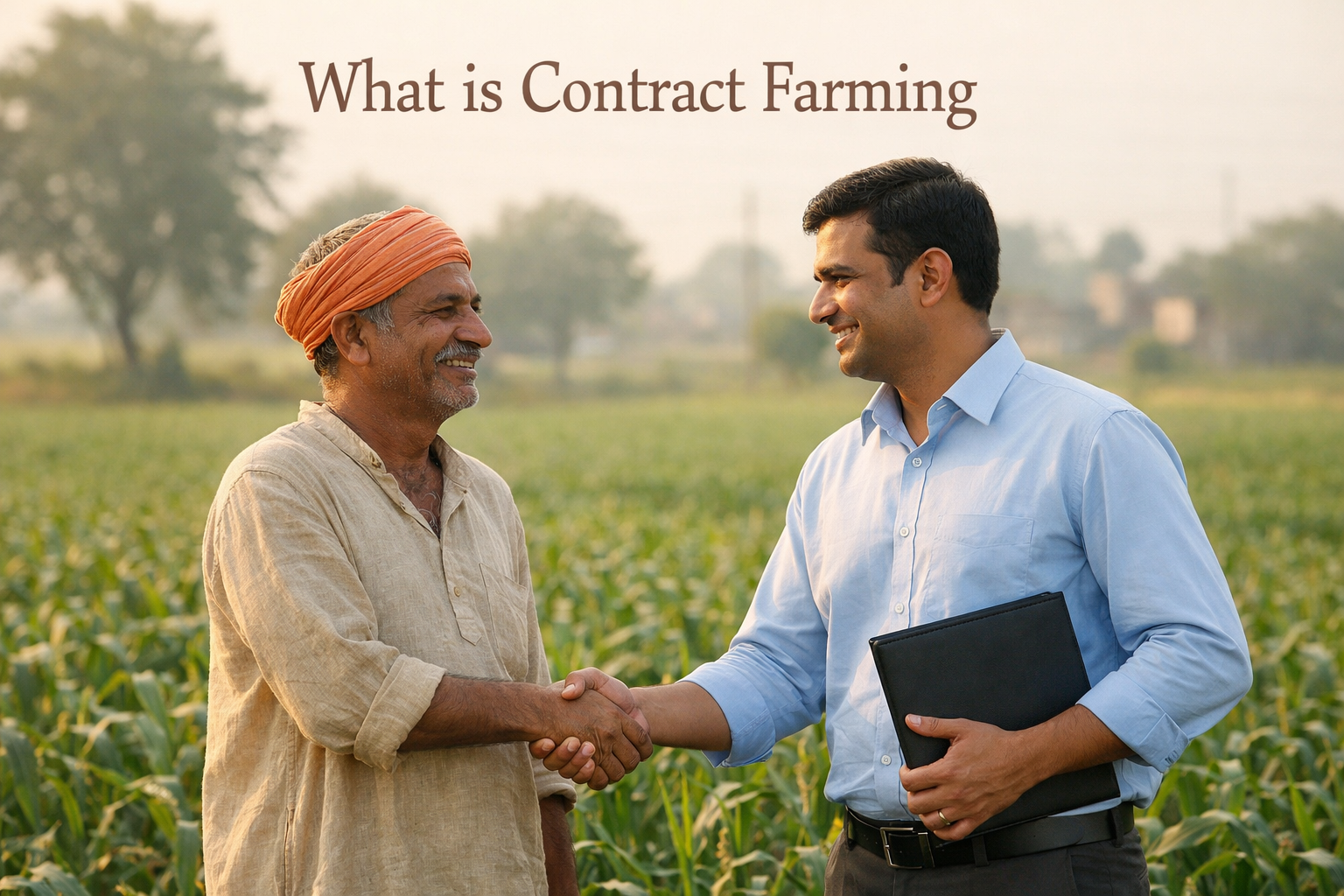
What is Contract Farming? Definition and How the System Works
For many farmers, selling crops has become uncertain. Even after putting in months of hard work, the final price often depends on market conditions, middlemen, and timing. Sometimes prices fall suddenly, and farmers are forced to sell at a loss.
Because of these challenges, many farmers are now looking for farming models that give more clarity and stability. One such model is contract farming. While many farmers have heard this term, not everyone is clear on how it actually works.
This blog explains what contract farming is, how it works, and what farmers should know before choosing it.
What is Contract Farming?
By definition, contract farming is a system where a farmer and a buyer make an agreement before the crop is grown.
In this agreement:
- The farmer agrees to grow a certain amount of a specific crop, following clear quality guidelines.
- The buyer agrees to purchase that crop.
- Important details like quality, quantity, delivery, and payment terms are decided in advance.
The buyer can be a company, processor, exporter, retailer, or agri-business. The farmer continues to own the land and grow the crop on their own field.
In simple words, contract farming means growing a crop with a confirmed buyer already in place.
Who is Involved in Contract Farming?
Usually, there are two main parties:
- The Farmer: who grows the crop.
- The Buyer: who purchases the crop after harvest.
In some cases, a platform or organization helps connect farmers with buyers and supports the process. This helps ensure transparency and better coordination.
How Does Contract Farming Work?
Contract farming follows a clear process. Understanding each step helps farmers decide better.
Step 1: Agreement Between Farmer and Buyer
Before sowing begins, both sides discuss and agree on:
- Which crop will be grown
- Expected quantity
- Quality standards
- Delivery method
- Payment process
The agreement is usually written so both sides are clear about their responsibilities.
Step 2: Crop Planning and Guidance
Once the agreement is done:
- The farmer plans the crop according to the buyer’s requirement.
- In some cases, guidance is provided on seeds, spacing, or farming practices.
The goal is to grow a crop that matches what was agreed upon.
Step 3: Cultivation as Per the Agreement
The farmer grows the crop on their land using agreed practices.
- The farmer manages daily farming activities.
- The buyer may monitor quality or provide suggestions, depending on the contract.
The farmer remains fully responsible for cultivation.
Step 4: Harvesting and Delivery
After harvest:
- The crop is collected or delivered as agreed.
- Quality is checked based on the contract terms.
Clear quality standards help avoid confusion at this stage.
Step 5: Payment to the Farmer
Once the crop is delivered:
- Payment is made according to the agreement.
- Timelines are already defined in the contract.
This reduces uncertainty compared to open market selling.
Types of Contract Farming
Contract farming can be done in different ways. Farmers should know the common types.
1. Market-Specification Contract
In this type:
- The buyer decides quality standards.
- The crop is purchased if it meets those standards.
This is one of the most common forms of contract farming.
2. Production-Management Contract
Here:
- The buyer provides guidance on farming practices.
- The farmer follows specific methods to grow the crop as required.
This type is common for crops that need strict quality control.
3. Resource-Providing Contract
In this model:
- The buyer may provide inputs like seeds or fertilizers.
- The farmer supplies the crop as agreed.
The cost of inputs is usually adjusted during final payment.
Key Benefits of Contract Farming for Farmers
Contract farming offers several practical advantages.
1. Assured Market for Produce
Farmers know in advance who will buy their crop. This removes the stress of finding buyers after harvest and allows them to focus fully on growing a good crop.
2. Price Clarity Before Sowing
The price or pricing method is decided before the crop is grown. Even if market prices change later, farmers already know what to expect, which helps in planning expenses and the next season.
3. Better Crop Planning
Since the crop, quantity, and quality are decided early, farmers can plan land use, inputs, and labor more efficiently throughout the season.
4. Less Effort in Selling the Produce
Farmers do not need to spend time or money searching for markets, transporting produce to multiple mandis, or negotiating prices after harvest.
5. Support to Grow Better Crops
In many cases, farmers get access to good quality seeds, fertilizers, and expert guidance. Guidance on the right farming practices helps improve crop health and overall yield.
6. Reduced Risk and More Stability
With a confirmed buyer and clear terms, one major farming risk is reduced. When combined with support like crop insurance, farmers get better protection for their hard work.
Common Myths About Contract Farming
There are many misunderstandings about contract farming. Let’s clear some of them.
Myth 1: Farmers Lose Ownership of Their Land
This is not true. In contract farming, farmers remain the owners of their land. The agreement is only about what crop is grown and the quality expected, not about land ownership.
Myth 2: Only Large Farmers Can Do Contract Farming
Small and marginal farmers can also participate. Many contracts are designed for groups of farmers or smaller landholdings.
Myth 3: Contracts Always Favor Companies
A fair and transparent contract protects both sides. Farmers should always read and understand terms before signing.
Is Contract Farming Legal in India?
Yes, contract farming is legal in India. Different states have guidelines to support it.
The key point for farmers is to:
- Ensure contracts are written clearly.
- Understand payment terms and quality conditions.
- Keep copies of agreements.
- Transparency is important for safety.
Challenges in Contract Farming That Farmers Should Know
Like any system, contract farming also has some challenges.
- Quality Rejection Risk: If crops do not meet agreed standards, buyers may reject or reduce payments. Clear quality definitions help avoid disputes.
- Dependence on One Buyer: Farmers rely on one buyer, so trust and clarity are important.
- Need for Clear Contracts: Unclear terms can create confusion. Farmers should ask questions before agreeing.
Being aware of these points helps farmers make informed decisions.
How Khetavya Helps Farmers with Contract Farming
Our role at Khetavya is to be the trustworthy link in this agreement.
We support farmers by:
- Connecting them with trusted buyers
- Ensuring transparent and clear agreements
- Supporting farmers throughout the farming process
- Focusing on farmer interests and fair practices
This makes the process easier and more reliable.
Contract Farming vs Traditional Farming (Quick Comparison)
Aspect |
Traditional Farming |
Contract Farming |
|---|---|---|
| Buyer | Found after harvest | Fixed before sowing |
| Price Clarity | Uncertain | Defined in advance |
| Market Risk | High | Lower |
| Planning | Difficult | Easier |
Is Contract Farming Right for You?
Contract farming is ultimately about replacing worry with a plan. It’s about knowing your effort will be rewarded and being able to look ahead to the next season with confidence. If the idea of a guaranteed sale, a fixed price, and a partner to support you sounds good, then it might be the right path for you.
If you want to understand whether contract farming is suitable for your land and crop, you can speak with our team. We’re happy to answer your questions and guide you.
Call or send us a message on WhatsApp today. Let’s grow together.