
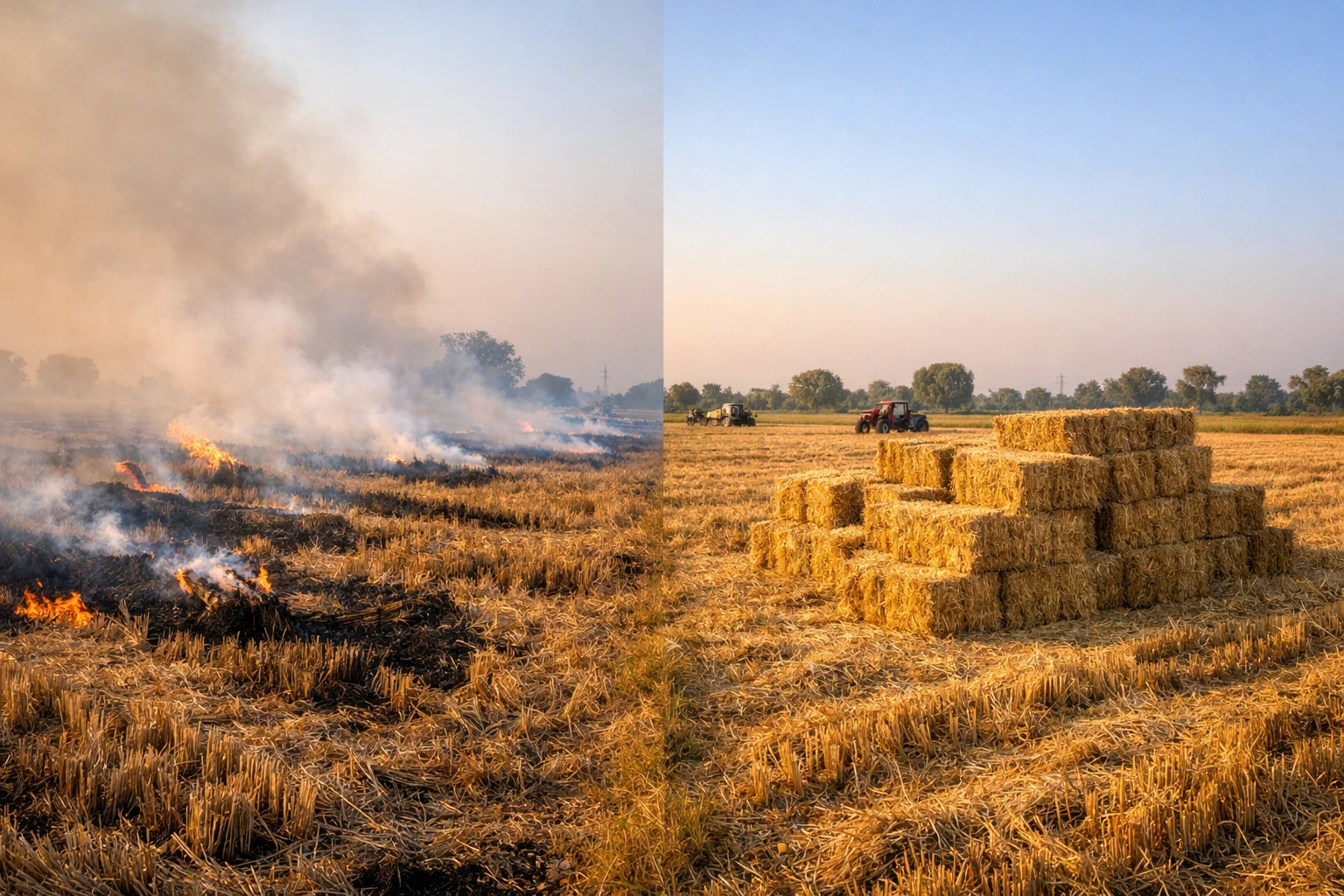
What is Biomass Management & How to Manage Crop Residue Without Burning
You’ve harvested your crop. The grain is sold or stored.
But your field is still covered in wheat straw, paddy stubble, cotton stalks, or sugarcane leaves.
With only a few weeks before the next sowing window opens, one question remains: What do you do with all this leftover crop residue?
Burning is fast, but it damages your soil. Manual removal is clean, but it costs time and labor.
There is a better way: biomass management.
This guide explains how to handle crop residue in a way that protects your land, saves time, and improves your long-term returns.
Why Burning Costs You More Than You Think
Let’s look at what actually happens when stubble burns.
1. You Lose Nutrients You Already Paid For
One ton of paddy straw contains approximately:
- 5–6 kg Nitrogen
- 2–3 kg Phosphorus
- 12–15 kg Potassium
When you burn, these nutrients either turn to ash or escape into the air. You paid for these nutrients through fertilizers. After burning, you must pay again to replace them.
2. Soil Biology Dies
During burning, the top 2–3 inches of soil can reach temperatures above 300°C.
Earthworms, fungi, and helpful bacteria cannot survive this heat. These organisms:
- Improve soil structure
- Help roots absorb nutrients
- Support long-term fertility
When they disappear, soil quality slowly declines.
3. Weed Growth Increases
After burning, soil is left bare. Weeds grow faster than crops in exposed soil.
This often leads to:
- Higher herbicide use
- More manual weeding
- Extra costs
4. Government Penalties Apply
In many states, stubble burning leads to fines ranging from ₹2,500 to ₹15,000 per incident.
Repeat violations may also affect:
- Subsidy eligibility
- Power connections
- Access to government schemes
The field may look clean after burning. But the soil underneath becomes weaker and costlier to maintain.
What is Biomass Management?
Biomass management is the collection of crop residue from fields for productive use elsewhere instead of burning it.
Every crop leaves behind plant matter. Paddy leaves stubble. Wheat leaves straw. Maize, cotton, and sugarcane leave stalks and leaves. This material is not waste. It is biomass: plant material that still contains energy, fiber, and nutrients.
Biomass management includes:
- Collecting residue properly
- Reusing or supplying it for productive use
- Preparing the field for the next crop
- Protecting soil health
Crop |
Residue Type |
Can Be Used For |
| Paddy |
Stubble, loose straw |
Paper, energy, compost |
| Wheat |
Straw, chaff |
Cattle bedding, energy, packaging |
| Maize |
Stalks, cobs, husk |
Compost, industrial fuel |
| Cotton |
Stalks, boll shells |
Particle board, energy |
| Sugarcane |
Dry leaves, tops |
Compost, boiler fuel |
Your role ends at collection. You do not find buyers. You do not arrange transport. You do not worry about where each bale goes. A service provider handles everything after the residue leaves your field.
Where Does Your Crop Residue Go?
Farmers ask this question more than any other. Here is the straight answer.
- To composting yards: Residue is stacked in long rows, moistened, and turned over several weeks. It decomposes into dark, nutrient-rich manure. This manure returns to farms, sometimes yours, sometimes others. No chemicals are added. It is simply decomposed plant matter.
- To bio-energy plants: Biomass is fed into industrial boilers. It burns at controlled high temperatures to generate steam and electricity. Unlike open burning, this process captures energy while releasing minimal smoke. The ash is sometimes returned to farms as a soil mineral supplement.
- To paper and packaging mills: Wheat straw and paddy straw have good fiber length. Mills use them to make cardboard, egg trays, and molded packaging. This reduces pressure on trees.
- To dairies: Straw becomes bedding for cattle. It absorbs moisture, keeps animals clean, and later mixes with dung to become farmyard manure.Nothing is burned. Nothing is wasted.
What Actually Happens When You Opt for Biomass Collection?
Here is the step-by-step process.
Step 1: Field Assessment
A person from the service provider walks your field after harvest. They look at:
- Crop type (wheat, paddy, cotton, maize, sugarcane)
- Quantity of residue
- Field accessibility
- Soil condition
- Your next sowing date
This takes 15–20 minutes. You receive a clear timeline and rate before any equipment enters your field.
Step 2: Mechanical Collection
Different crops require different tools. The service provider brings the right machinery.
| Crop | Equipment Used |
What it Does |
| Paddy, Wheat |
Baler |
Picks up loose straw, compresses into compact bales |
| Maize, Cotton |
Shredder + Baler |
Cuts stalks into small pieces, then bales them |
| Sugarcane | Raker + Baler |
Gathers trash into rows, then collects it |
You need to do nothing. The team operates all equipment. You do not arrange labor, tractors, or transport.
Step 3: Field Clearance
Bales are loaded onto trucks and taken away. Your field is now clear. No ash. No half-burned stalks. No standing stubble.
Step 4: Responsible Utilization
Collected biomass may go to bio-energy plants, composting yards, paper mills, or dairy farms for bedding.
Step 5: Confirmation
You receive confirmation that your field is cleared and the residue was not burned. You have no legal liability.
For an average-sized field, the entire process usually takes 1–2 days.
Methods of Biomass Management
Here are some practical approaches farmers use:
1. Mechanical Collection
Using machines to collect and remove stubble is one of the most effective options. It prepares land quickly and reduces manual effort.
2. Mulching
In some cases, residue can be spread evenly across the field to protect soil moisture and reduce weeds.
3. Composting
Collected biomass can be converted into compost and returned to the soil as organic manure.
4. Biomass Utilization
Residue can be supplied for biofuel production or other agricultural applications, creating structured usage instead of waste. Each method depends on farm size, crop type, and available resources.
Biomass Management for Different Farm Sizes
For Small Farms (1–5 Acres)
Your main concerns are cost control and avoiding fines. You cannot afford to invest in machinery. You also cannot afford penalties.
The practical approach is village-level aggregation and cluster-based collection. When multiple small farmers in one area book biomass collection together, service providers offer discounted cluster rates. Your per-acre cost comes down. Your field gets cleared. You stay compliant.
For Medium-Sized Farms (5–20 Acres)
Your main concern is speed and turnaround time. With two or three crop cycles per year, any delay affects your next season's income.
Mechanical collection completes in one day what manual labor takes a week to finish. You hit your sowing window. You also retain more soil nutrients, reducing your fertilizer bill over time.
For Large Farms & Agribusinesses (20+ Acres)
Your main concerns are operational efficiency and documentation. You need consistent service across multiple fields, sometimes across districts.
Professional biomass services can clear hundreds of acres in a single week. More importantly, they provide traceability. If you sell to corporate buyers or require sustainability certifications, you receive records that prove zero-burn compliance for audits.
No matter the size of the farm, biomass management supports better planning and soil care.
How to Get Biomass Managed on Your Farm
Khetavya’s Biomass Solutions focuses on post-harvest field cleaning and responsible residue handling.
The process is straightforward:
- Call or WhatsApp the helpline number on the website.
- Share your location, crop type, and field size.
- A field visit confirms feasibility, rate, and schedule.
- Collection happens on the agreed date.
- Your land is ready for the next crop.
The entire process is explained clearly before work begins without any hidden charges or forced contracts.
Clear the Field Without Weakening the Soil
Biomass management is not just about ‘cleaning a field’ or ’saving the environment’ in some abstract sense.
It is about:
- Protecting soil nutrients
- Reducing fertilizer expenses
- Saving labor costs
- Avoiding government penalties and legal trouble
- Starting the next crop on time
Burning may seem faster, but when you calculate nutrient loss, weed growth, and penalties, it is rarely cheaper.
You harvested one crop. Clear the field in a way that protects the next one.