
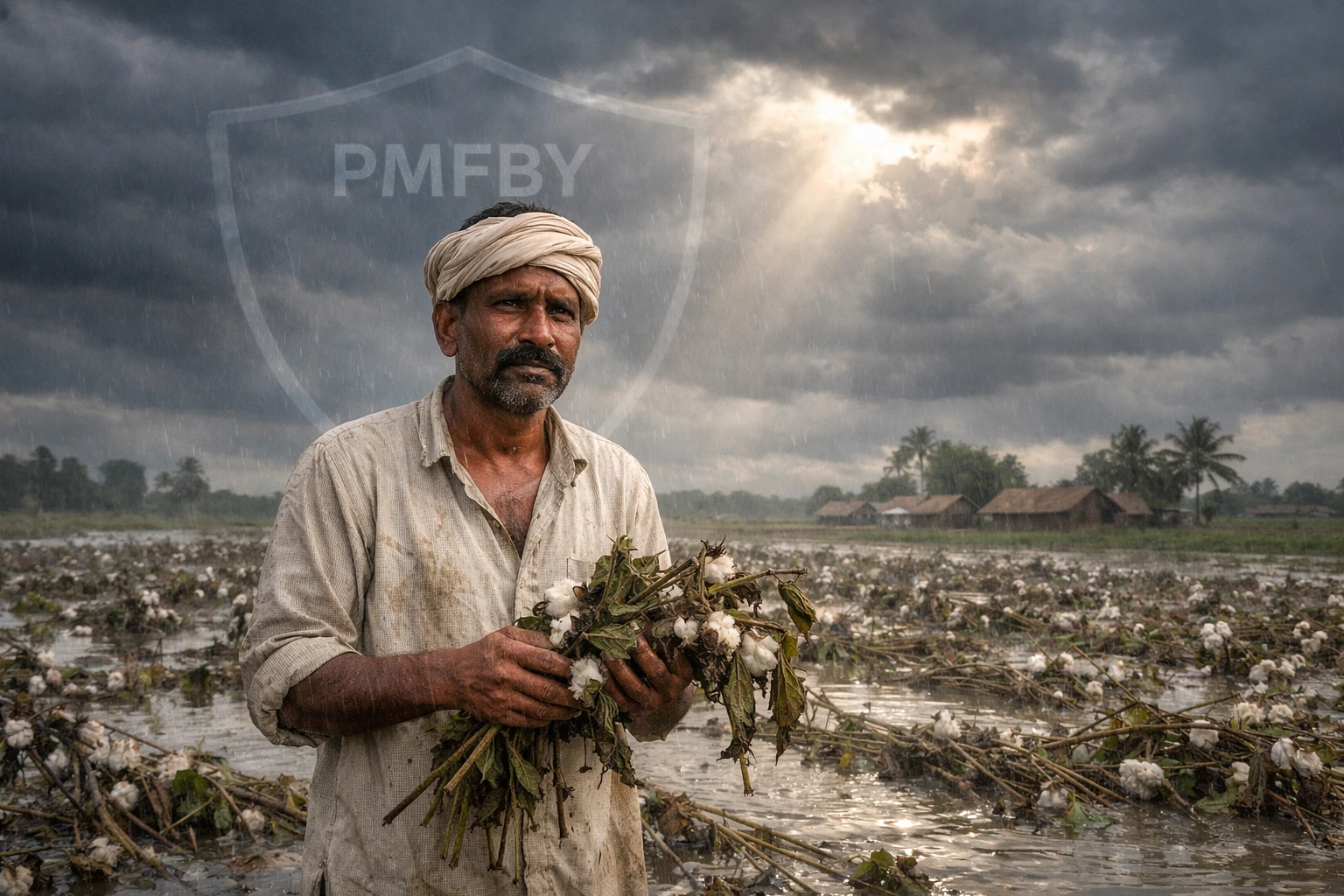
PMFBY (Pradhan Mantri Fasal Bima Yojana): Crop Insurance for Farmers in India
A farmer worked his fields all season, sowing on time, watering carefully, waiting for harvest. Then, just weeks before cutting, unseasonal heavy rain destroys the entire crop.
No harvest. No income. And no way to repay the input costs already spent.
This isn’t rare. It happens every season across India. The weather is unpredictable. Pests don’t warn you. And when crops fail, the farmer bears the entire risk.
That’s why the Government of India launched Pradhan Mantri Fasal Bima Yojana (PMFBY) in 2016 to protect farmers from such losses.
PMFBY Quick Glance:
- Pay: 1.5%–5% premium
- Covers: Flood, drought, pests, rain damage
- Claim: Report within 72 hours
- Payout: Direct bank transfer
What is PMFBY?
PMFBY is a government crop insurance scheme. If your crop gets damaged due to natural reasons like flood, drought, hailstorm, pest attack, or other covered reasons, the scheme pays you compensation directly into your bank account.
You pay a small premium. The state and central government pay the rest on your behalf to the insurance company.
It covers:
- Kharif crops
- Rabi crops
- Horticulture and commercial crops
All farmers can apply: small, large, tenant, or sharecropper.
What Does PMFBY Cover?
PMFBY covers a wide range of situations where crop loss is not your fault.
Before harvest:
- Flood, drought, dry spell
- Hailstorm, cyclone, storm
- Pest attacks and crop diseases
- Prevented sowing (if you couldn’t sow at all)
After harvest (within 14 days):
If you have cut your crop and left it in the field to dry, and rain or hailstorm damages it within 14 days of cutting, that loss is also covered
Localised risks:
- Hailstorm
- Landslide
- Waterlogging (even if only your field is affected)
What is NOT covered:
You will NOT get compensation if:
- You did not report damage within 72 hours
- Loss is due to negligence
- Crops that are not listed as notified crops under the scheme in your district
- Damage due to war, nuclear incidents, or wilful destruction
How Much Premium Do You Pay?
This is the part most farmers are surprised by, because the premium is very low.
Crop Type | Premium |
| Kharif crops (cotton, soybean, maize, etc.) | 2% |
| Rabi crops (wheat, gram, mustard, etc.) |
1.5% |
| Horticulture and commercial crops |
5% |
Example:
If your wheat crop is insured for ₹40,000, you pay just ₹600. The government pays the rest. You pay a small amount. The protection is for the full insured value.
Who Can Apply for PMFBY?
- Farmers growing notified crops
- Loanee farmers (auto-enrolled via KCC, but verify)
- Non-loanee farmers (must apply manually)
- Tenant and sharecropper farmers
You don’t need to own land, but you need valid proof.
How to Apply for PMFBY
You can enroll through any of these ways:
- Your bank branch
- Common Service Centre (CSC), the Jan Seva Kendra in your village or town
- PMFBY website → pmfby.gov.in
- PMFBY mobile app
Documents Required:
- Aadhaar card
- Land records (7/12 extract, Khasra, or Khatauni)
- Bank passbook
- Sowing certificate or self-declaration of sowing
Enrollment Deadlines: Do Not Miss These
Season | Last date to enroll |
| Kharif |
~July 31 |
| Rabi |
~December 31 |
If you miss the enrollment deadline, you cannot get coverage for that season. There are no exceptions.
How to File a Claim: Step by Step Procedure
Many farmers enroll in PMFBY but do not know how to claim. Or they wait too long and their claim gets rejected.
Step 1: Report within 72 Hours
As soon as your crop is damaged, you must inform within 72 hours. This is a strict deadline. If you miss it, your claim can be rejected.
- Call the PMFBY toll-free number: 14447
- Inform bank or insurance company
- Use PMFBY mobile app
Step 2: Field Survey
After you report, officials will visit your field and do a crop cutting survey.
They assess how much of the crop has been damaged and compare it against the threshold yield for your area.
Step 3: Compensation Calculation
The compensation is based on the survey result. If the actual yield is lower than the guaranteed threshold yield for your district, you receive the difference as compensation.
Step 4: Money Credited
The amount is credited directly to your bank account through DBT (Direct Benefit Transfer).
One important tip: Take photos of damage with date/location before clearing the field.
Example: How Payout Works
If your insured amount is ₹40,000 and your yield drops significantly, you may receive compensation based on the loss (e.g., ₹15,000–₹25,000 depending on assessment).
Useful Tools for PMFBY
- PMFBY Mobile App: Check your policy status, file a crop loss intimation, track your claim, and raise complaints, all from your phone.
- pmfby.gov.in: Check if your crop and area are notified under the scheme. Also use the premium calculator to see exactly how much you will pay before enrolling.
- Bhuvan App (by ISRO): Used by some states for farmers to geotag their field photos as supporting evidence for claims.
Mistakes That Lead to Claim Rejection
Many farmers enroll but never receive compensation, not because the scheme failed, but because of avoidable mistakes.
- Not enrolling at all: Assuming the bank or government has done it automatically
- Missing the deadline: Even one day late means no coverage for that season
- Not reporting damage within 72 hours: The most common reason claims are rejected
- Wrong or inactive bank account: Compensation cannot be transferred if your account is not linked or updated
- Not keeping the enrollment receipt: Always ask for and save your acknowledgement slip
The Difference Between PMFBY and RWBCIS
There’s another scheme called RWBCIS → Restructured Weather Based Crop Insurance Scheme.
- PMFBY: Pays based on actual crop loss (field survey)
- RWBCIS: Pays based on weather data (rainfall, temperature, humidity)
Both are government schemes with similar low premiums. Which one is available in your area depends on your state and district.
PMFBY: Protect Your Crops, Income, and Future
A single crop failure should not destroy a farmer’s financial stability.
PMFBY exists to reduce that risk.
The premium is low. The protection is real.
But it only works if you:
- Enroll on time
- Report damage within 72 hours
- Keep your documents ready
At Khetavya, we help farmers with crop insurance guidance from enrollment to claim filing. If you are unsure whether your crop is covered, or need help understanding the scheme in your area, our team is here to guide you.
Don’t wait for a loss. Get insured this season.