
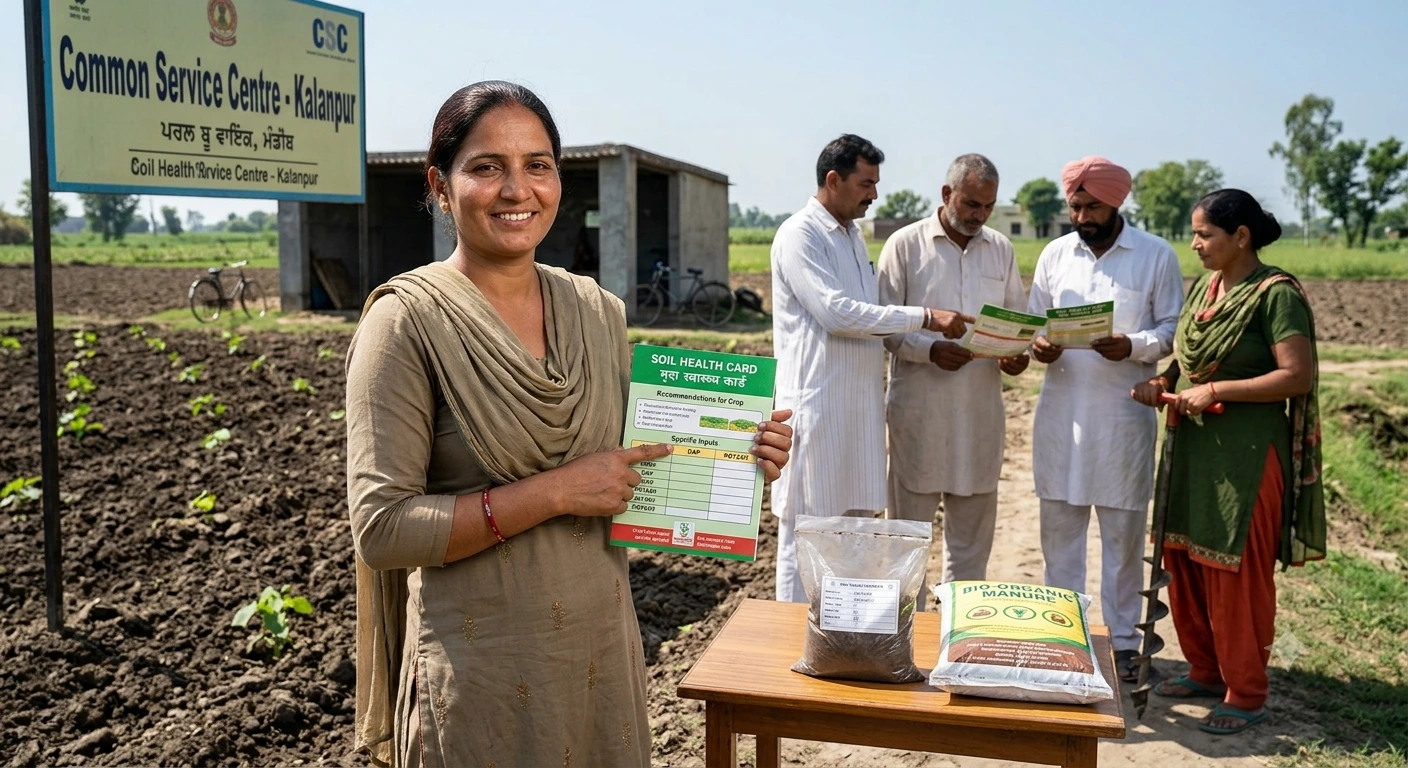
Soil Health Card Scheme: What It Is, How to Apply, and How to Use It
Most farmers know their land well. They know which part of a field holds water, which patch consistently produces weaker crops, and where they need to apply more fertilizer. What is harder to know is why these differences occur.
- Is the soil actually deficient in nitrogen?
- Does it need more phosphorus or potassium?
- Could a micronutrient such as zinc be limiting crop growth?
- And are you applying more fertilizer than the crop really needs?
The Soil Health Card (SHC) Scheme was introduced to help answer these questions through scientific soil testing and crop-specific fertilizer recommendations. But getting a card is only the first step. The real value comes from understanding the results and using them to make better decisions about fertilizers, crops, and soil management.
What is the Soil Health Card Scheme?
The Soil Health Card Scheme is a Government of India initiative launched in 2015 to help farmers understand the nutrient condition of their soil.
A Soil Health Card provides information about important soil properties and nutrients and gives recommendations on fertilizer application for the crops planned on that land.
Instead of applying fertilizer based mainly on habit, previous seasons, or advice from others, farmers can use soil test results to determine what their field actually needs.
The scheme is run by the Department of Agriculture & Farmers Welfare, and the official portal is soilhealth.dac.gov.in.
Because government testing and reporting systems are periodically updated, farmers should check the official portal or their local agriculture office for the latest information on registration, testing cycles, and card availability.
Why is Soil Testing Important?
Fertilizer is an important farm input, but more fertilizer does not necessarily mean higher yields.
Repeatedly applying the same fertilizer without knowing the soil's nutrient status can result in some nutrients being over-applied while others remain deficient.
Common problems include:
- Excessive application of nitrogen-based fertilizers such as urea.
- Insufficient attention to phosphorus and potassium requirements.
- Micronutrient deficiencies, particularly zinc and boron in some regions.
- Unnecessary spending on fertilizers the crop may not require.
- Gradual deterioration of soil fertility and nutrient balance.
A Soil Health Card doesn't just tell you what's wrong, it tells you specifically what to correct, and by how much.
If you'd rather understand the mechanics of getting your soil tested before sowing, our detailed guide on soil testing before sowing covers that process step by step.
What Does a Soil Health Card Show?
A Soil Health Card generally reports important physical and chemical properties and nutrient levels of the tested soil.
These can include:
- Primary nutrients: Nitrogen (N), Phosphorus (P), and Potassium (K)
- Secondary nutrients: Sulphur, Calcium, and Magnesium
- Micronutrients: Zinc, Iron, Manganese, Copper, Boron, and others
- Other properties: Soil pH, electrical conductivity, and organic carbon
The report doesn't simply provide numbers. It can also classify nutrient levels and provide crop-wise fertilizer recommendations.
For example, depending on the test results and crop, the recommendations may indicate appropriate quantities of nitrogen, phosphorus, potassium, or specific micronutrients.
Who Can Get a Soil Health Card?
The Soil Health Card programme is intended for farmers across India. The exact registration and verification process can vary by state.
Farmers may need details such as:
- Aadhaar or other identification details
- A mobile number for communication or OTP verification where applicable
- Land records, such as survey, khata, or khasra details
- Information about the crop being grown or planned
Government employees and income-tax payers are typically excluded from many DBT-linked farmer schemes, so if you're applying through a scheme aggregator or CSC, it's worth confirming eligibility specifics for your state.
How to Apply for a Soil Health Card
Online Process
The process can vary as government portals are updated, but generally involves:
- Visit the official Soil Health Card portal at soilhealth.dac.gov.in.
- Register using your Aadhaar number and mobile OTP.
- Enter your land details: khata/khasra number or survey number, along with location.
- Provide information about the crop or cropping pattern where required.
- Arrange for or await collection of the soil sample through the designated department or testing facility.
- The sample is analysed in a soil testing laboratory.
- Once the report is prepared, the Soil Health Card or soil test report can be accessed on the portal, and often through SMS or the mobile app as well.
Offline or Assisted Registration
Farmers who aren’t comfortable applying online and prefer assistance can approach:
- Common Service Centres (CSCs)
- Local agriculture department offices
- Krishi Vigyan Kendras (KVKs)
- Agriculture camps or Kisan Melas organised by state authorities
Soil sample collection is typically arranged by the department after registration. You don't need to send samples yourself in most cases, though the exact process can vary by state.
How to Check Your Soil Health Card Status
Once your soil sample has been submitted and processed, you can check the status through the official Soil Health Card system, where the relevant facility is available.
- Go to soilhealth.dac.gov.in.
- Look for the option to check status or download your report.
- Enter your registration number or Aadhaar-linked details.
- Your card, once ready, can usually be viewed and downloaded directly, or accessed via the mobile app.
If your report is not available after the expected processing period, contact the local agriculture department, soil testing laboratory, or CSC that helped with registration.
What are the Benefits of Soil Health Card for Farmers?
A Soil Health Card can help farmers make more informed decisions about soil and fertilizer management.
1. More Precise Fertilizer Application
Instead of applying fertilizer purely by routine, farmers can use test results to identify nutrient requirements.
2. Potential Reduction in Input Costs
Avoiding unnecessary fertilizer applications can reduce expenditure while ensuring essential nutrients are supplied.
3. Better Nutrient Management
Identifying deficiencies in nutrients such as zinc, sulphur, or boron can help address problems that may otherwise go unnoticed.
4. Improved Soil Management
Regular testing provides a way to monitor changes in soil fertility over time.
5. Better Crop Planning
Understanding soil characteristics can support decisions about crop selection and crop diversification. Our guide on crop diversification for better income explores this further.
Don't Just Get the Soil Health Card, Use It
One of the biggest mistakes is treating the Soil Health Card as the final step.
A report is useful only when its recommendations are translated into action.
For example, if your card shows a nutrient deficiency, don't automatically purchase a fertilizer simply because the nutrient name appears on the report.
Understand:
- Which input should be used?
- How much should be applied?
- At what stage should it be applied?
- Should it be applied to the soil or crop?
- Does the recommendation change depending on the crop?
It is also important to remember that a soil test represents the condition of the sampled area at the time of testing. Nutrient levels can change with cropping patterns, irrigation, fertilizer application, and other factors. Periodic testing can therefore provide more useful information than relying on one report indefinitely.
Where Does the Soil Health Card Fall Short?
A Soil Health Card can provide valuable information, but it cannot solve every soil or crop problem by itself.
Soil health is influenced by much more than nutrient levels. Water management, organic matter, crop rotation, irrigation, pests, diseases, weather, and cultivation practices can all affect crop performance.
More importantly, farmers may receive a technically correct report without fully understanding what the numbers mean for their particular field.
That is why interpretation and follow-up matter.
If your report identifies a deficiency you have never dealt with before, discuss the recommendation with a qualified agricultural expert or local agriculture officer before making significant changes to your fertilizer programme.
How Soil Health Data Can Support Other Farm Decisions
The information from soil testing can complement wider farm planning, including:
- Fertilizer management: Apply nutrients according to actual soil requirements.
- Farm budgeting: Reduce avoidable expenditure on unnecessary inputs.
- Crop planning: Select crops better suited to field conditions.
- Soil improvement: Identify areas requiring corrective measures.
- Record keeping: Compare soil conditions across testing cycles.
For a broader approach to reducing expenditure, see our guide on how to reduce farming costs.
How Khetavya Can Help
Getting a Soil Health Card is only the beginning. Understanding the results and turning them into an actionable farm plan is where the real value lies.
Through our Soil, Water & Crop Testing service, Khetavya can help farmers go beyond basic soil testing when additional analysis is required.
We help interpret test results in practical terms:
- what your soil needs
- what to apply
- how much to use
- when to apply it
Whether you're preparing for the next sowing season or trying to understand why a field is consistently underperforming, a properly interpreted soil test can be a useful starting point for better farm decisions.