
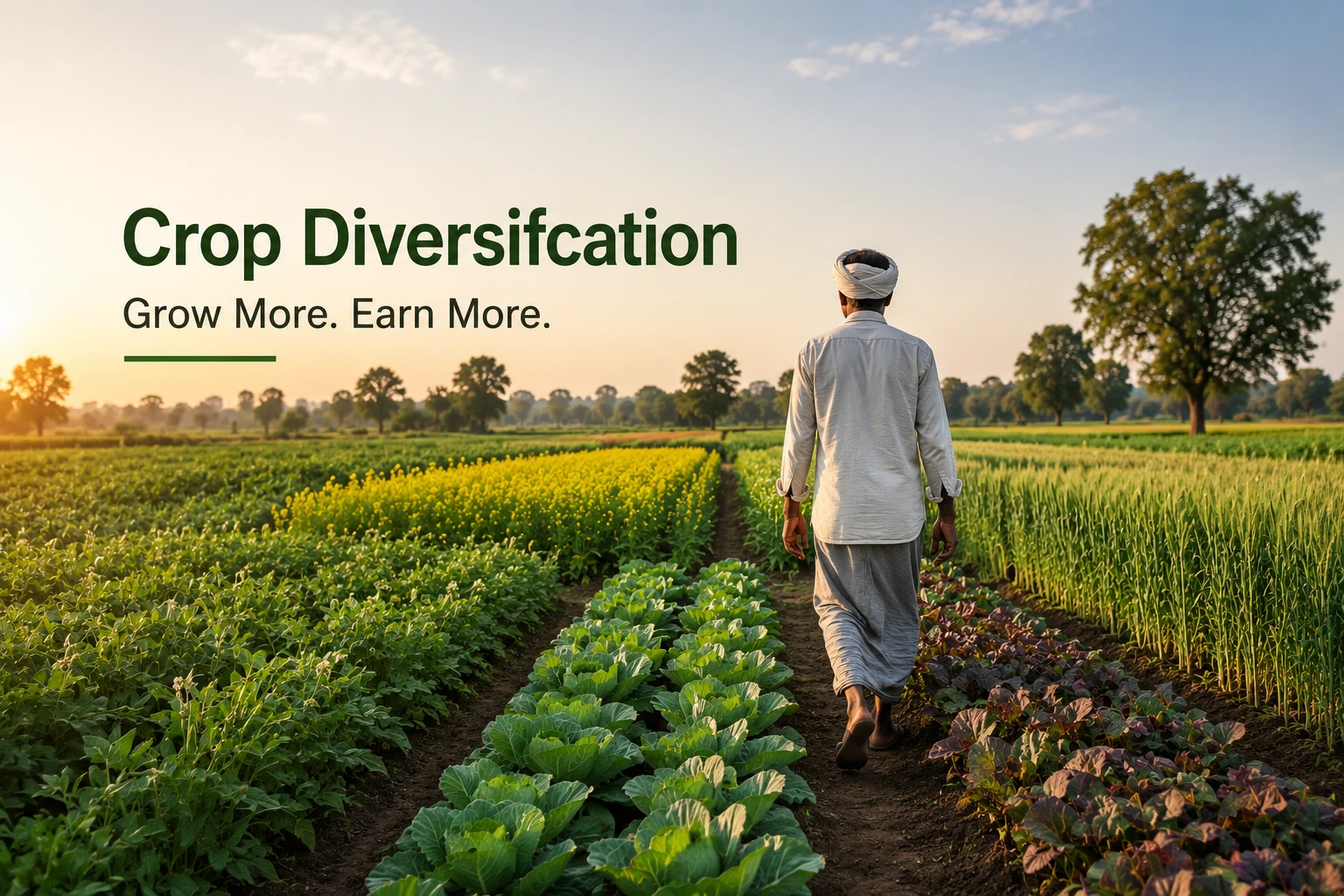
Crop Diversification: How Farmers Can Increase Their Income
If you've grown the same crop, or the same crop pair, season after season, you already know the pattern. A good harvest year floods the market, prices fall, and the extra effort you put in barely shows up in your pocket. A bad year, and there's nothing to fall back on because everything you grew depends on the same weather, the same pests, and the same buyers.
This is the risk of monocropping, and it's one of the biggest reasons farm income in India stays unpredictable year after year.
Crop diversification is one of the simplest ways to fix this. It doesn't mean giving up the crop you know best. It means reducing how much your income depends on just one of them.
In this guide, we'll break down why diversification matters, how to plan it without taking unnecessary risk, and how Khetavya can support you throughout the journey.
Why Monocropping Reduces Farmer Income
Many farmers continue growing the same crop because it has worked well in the past, the entire region grows it, or switching feels risky. While this approach may seem safe, it creates several long-term challenges.
1. Price Volatility
When most farmers harvest the same crop at the same time, market supply rises sharply. Increased supply often pushes prices down, meaning even a bumper harvest may generate lower profits.
2. Declining Soil Health
Repeatedly growing the same crop removes the same nutrients from the soil every season. Over time, this reduces soil fertility and increases dependence on fertilizers simply to maintain previous yield levels.
3. Higher Production Risk
A pest outbreak, disease, or extreme weather event affecting your single crop can result in losing your entire season's income. With no alternative crop, there's little protection against unexpected losses.
4. Missed Profit Opportunities
Many farmers never explore crops such as pulses, oilseeds, vegetables, spices, or horticultural crops, even though they often offer higher returns than traditional staples in the right market.
What Crop Diversification Actually Means
Crop diversification isn't a single technique. Depending on your land, water availability, and farming goals, it can take different forms.
1. Crop Rotation
Growing different crops in a planned sequence across seasons. For example, cereals followed by legumes and then oilseeds. Crop rotation naturally restores soil nutrients and helps reduce pest and disease build-up.
2. Intercropping
Growing two compatible crops together on the same field, such as maize with pulses. This improves land utilization while generating income from multiple crops.
3. Adding a Cash Crop
Instead of replacing your main crop, dedicate a portion of your land to vegetables, spices, fruits, or other high-value crops. Growing these under organic certification can further improve margins, since certified produce often commands a premium in the market.
The goal isn't to abandon what already works, it's to add more opportunities alongside it.
How Diversification Improves Farm Income
1. More Stable Earnings
Different crops respond differently to market conditions. If the price of one crop falls, another may still perform well, helping stabilize your overall income.
2. Lower Input Costs
Including legumes in your crop rotation naturally adds nitrogen to the soil, reducing fertilizer requirements for the following crop. Over time, this can significantly lower production costs. (We've covered additional cost-saving strategies in our guide on reducing farming costs.)
3. Better Market Opportunities
Certain crops consistently command higher prices due to stronger demand or limited local supply. Diversifying allows you to tap into these higher-value markets, especially when you're able to sell your crops directly without middlemen.
4. Greater Climate Resilience
Every crop reacts differently to drought, heavy rainfall, heat, or changing weather conditions. A diversified farm is far less vulnerable than one dependent on a single crop.
How to Choose the Right Crops to Diversify Into
This is where a lot of farmers go wrong, not because diversification doesn't work, but because the crop choice isn't matched to the land.
1. Start with Your Soil
A profitable crop for one farmer may not perform well on another farm. Conducting a soil test helps identify which crops your land can support before investing in seeds or inputs. Our guide on soil testing before sowing explains why this step matters.
2. Understand Local Demand
High-value crops only generate better income if there's a reliable market. Before planting, identify buyers, processors, or traders who purchase that crop in your area.
3. Consider Water Availability
Choose crops that match your irrigation capacity. Some crops require significantly more water than others, making them unsuitable for areas with limited water resources. Exploring modern irrigation technologies and subsidies can also help you expand the range of crops your land can support.
4. Begin on a Small Scale
There's no need to convert your entire farm in one season. Allocate a small section of your land to a new crop, evaluate the results, and expand gradually as you gain confidence.
Reducing the Risk of Trying a New Crop
The biggest concern for most farmers is simple: What if the new crop doesn't sell?
Fortunately, there are practical ways to reduce this risk.
- Contract Farming: It allows you to secure a buyer and often a price before sowing. This provides greater income certainty and reduces marketing risk.
- Farmer Producer Organisations (FPOs): Joining an FPO gives you access to collective buying, shared knowledge, and stronger market connections, making diversification easier and less risky.
- Direct Crop Sourcing: Direct sourcing connects farmers with buyers outside traditional mandi networks, creating opportunities for crops that may not yet have strong local demand.
Government Support for Crop Diversification
Several Indian states promote crop diversification through programmes under Rashtriya Krishi Vikas Yojana (RKVY) and other state-level initiatives. These schemes often encourage farmers to shift from water-intensive or low-value crops to more sustainable and profitable alternatives.
Support varies by state, so it's worth checking with your local agriculture department to understand the schemes available in your region.
You can also combine these programmes with benefits such as your Soil Health Card, PM-KISAN assistance, and a Kisan Credit Card to make the transition more affordable.
How Khetavya Helps Farmers Diversify with Confidence
Trying a new crop often requires different equipment, new buyers, and reliable guidance. Khetavya brings these essentials together in one platform.
We help farmers by providing:
- Machinery rental for different crop types without the expense of buying new equipment.
- Buyer connections for crops that may not yet have a strong local market.
- End-to-end support, from planning what to grow to helping you sell your harvest.
Our objective is simple:
|| Help farmers increase income while reducing the risks that usually come with trying something new.
Increase Farm Profit with Smart Crop Diversification
Crop diversification isn't about taking bigger risks, it's about managing them more effectively. By growing multiple crops, you reduce dependence on a single market, improve soil health, protect yourself from weather-related losses, and create opportunities to earn more from your land.
The best approach is to start small, choose crops that match your soil and local demand, and use the right support systems to make informed decisions.
If you're planning to diversify your farm but aren't sure where to begin, Khetavya can help you identify suitable crops, connect with reliable buyers, and build a practical diversification plan that works for your land and your goals.