
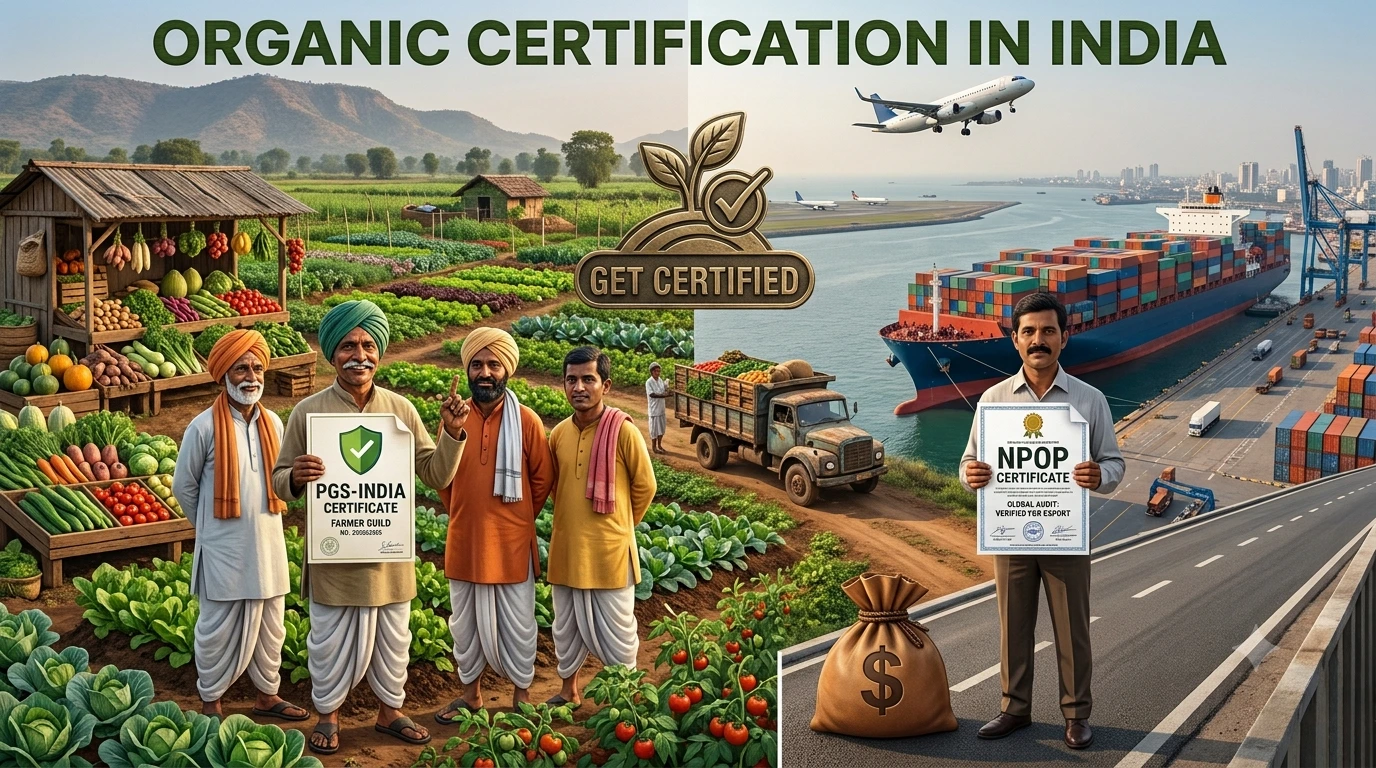
Organic Farming Certification in India: Guide for Farmers
Organic farming is no longer a niche practice. More people want organic food today than ever before. They're willing to pay more for it too. But if you're a farmer growing without chemicals, that alone doesn't get you the "organic" tag or the better price that comes with it. You need official certification to prove your claims.
This guide explains what organic certification is, the two certification systems available in India, and how to choose the right one based on your farming goals.
What is Organic Certification?
Organic certification is an official verification that your farm follows approved organic farming practices.
It confirms that your crops are grown without:
- Synthetic fertilizers
- Chemical pesticides
- Genetically Modified Organisms (GMOs)
- Other prohibited substances under organic standards
The certification is issued only after your farming practices are inspected and verified by an approved certification system.
Why is Organic Certification Important?
Certification does much more than allow you to use the word organic. It helps build credibility and opens new business opportunities.
Benefits of Organic Certification
- Builds trust among buyers and consumers.
- Allows access to organic retail stores, supermarkets, and institutional buyers.
- Enables exports to international markets (with the appropriate certification).
- Helps your produce earn premium prices.
- Differentiates your products from farms making unverified "natural" or "chemical-free" claims.
The right certification depends entirely on who you plan to sell to.
Two Organic Certification Systems in India
India offers two primary certification pathways:
- PGS-India (Participatory Guarantee System)
- NPOP (National Programme for Organic Production)
Both are government-recognized but serve different purposes.
PGS-India (Participatory Guarantee System)
PGS-India is a peer-review certification system designed primarily for small and marginal farmers selling within India.
Instead of external inspectors, farmers in a local group inspect and certify one another under established guidelines.
How PGS-India Works
- At least five farmers form a local group.
- Each farmer signs a pledge to follow organic practices.
- Members conduct mutual farm inspections.
- After approval, each farmer receives an individual PGS-India certificate, valid for one year.
- The certificate includes a QR code that buyers can verify.
Advantages of PGS-India
- Free of cost
- Government-recognized
- Simple and farmer-friendly
- Faster certification process
- Ideal for small-scale farmers
It is particularly suitable if you sell through:
- Local mandis
- Farmers' markets
- Direct farm sales
- WhatsApp or community groups
- State procurement programs such as school or hospital canteens
Limitations of PGS-India
While PGS-India is excellent for domestic local markets, it has certain limitations. It is generally not accepted for exports, and many large retail chains, food processing companies, and e-commerce platforms require third-party certification instead. If your focus is building a strong local customer base, PGS-India is often sufficient.
NPOP (National Programme for Organic Production)
NPOP is India's official third-party organic certification system, administered by APEDA under the Ministry of Commerce.
This certification is intended for farmers supplying:
- Export markets
- Large retail chains
- Food processors
- Institutional buyers
- Companies requiring internationally recognized certification
How NPOP Works
NPOP is more rigorous and more expensive than PGS-India. The certification is carried out by an accredited certification agency.
Some recognized certification bodies include INDOCERT, OneCert Asia, Control Union, Ecocert India.
Farmers must maintain detailed records throughout the certification process.
Key Requirements for NPOP
- Conversion Period: Land must undergo a 2–3 year conversion period, during which it is managed organically. During this period, the produce generally cannot be sold as certified organic.
- Record Keeping: Farmers are required to maintain detailed documentation, including farm diary, crop management records, input purchase records, field activity logs.
- Regular Inspections: Certification bodies conduct periodic inspections to verify compliance.
- Transaction Certificates: Each export shipment requires a separate Transaction Certificate before export.
International Recognition
NPOP certification is recognized by:
- European Union (EU)
- Switzerland
For exports to the United States, particularly processed organic foods and certain animal products like honey or ghee, additional certification under the USDA National Organic Program (USDA NOP) may also be required.
PGS-India vs NPOP: Which Should You Choose?
Your choice should depend on your target market rather than the certification itself.
PGS-India |
NPOP |
|---|---|
| Free certification | Paid certification |
| Peer-reviewed | Third-party inspected |
| Best for local markets | Required for exports |
| Faster process | Longer certification process |
| Minimal documentation | Extensive documentation |
| Suitable for small farmers | Suitable for commercial operations |
Choose PGS-India if you:
- Sell directly to consumers.
- Operate in local markets.
- Supply nearby retailers.
- Are beginning your organic farming journey.
Choose NPOP if you:
- Plan to export.
- Supply supermarkets or institutional buyers.
- Need internationally accepted certification.
- Want access to premium organized markets.
A Practical Approach for Most Farmers
Many farmers begin with PGS-India because it is free, easier to obtain, and helps establish organic farming practices.
As demand grows and buyers begin requesting third-party certification, they can transition to NPOP.
Maintaining proper farm records under PGS-India can also help support a future NPOP application, although individual certification bodies may have their own documentation requirements.
Another effective option is joining a Farmer Producer Organization (FPO) that already holds NPOP certification. Under the FPO's Internal Control System (ICS), members can benefit from shared inspections, reduced certification costs, and simplified documentation.
Government Support for Organic Farmers
The Government of India offers several schemes to encourage organic farming.
Paramparagat Krishi Vikas Yojana (PKVY)
PKVY provides financial assistance and technical support to farmer clusters adopting organic farming. The scheme is closely linked with PGS-India certification.
Mission Organic Value Chain Development for North Eastern Region (MOVCDNER)
This scheme supports organic farming, certification, and value chain development for farmers in India's Northeastern states.
Unified India Organic Logo
Introduced in 2024, the Unified India Organic logo replaced the earlier India Organic and Jaivik Bharat marks, giving consumers one recognizable symbol for certified organic products.
Common Challenges Farmers Face
Organic certification offers significant advantages, but farmers should be prepared for certain challenges.
- Certification Costs: Third-party certification under NPOP can be expensive, especially for small and marginal farmers, so it helps to plan your farming costs in advance.
- Conversion Period: During the 2–3 year transition period, farmers follow organic practices without receiving certified organic prices.Documentation: Maintaining consistent farm records requires discipline and careful management.
- Market Confusion: Unverified labels such as "natural" or "chemical-free" often create confusion among consumers, making certification even more valuable.
- Initial Yield Reduction: Many farms experience temporary yield reductions while the soil ecosystem adjusts to organic management before long-term improvements become visible.
Understanding these challenges helps farmers plan their transition more effectively.
Your Next Step Towards Organic Farming Certification
Organic certification is far more than a certificate, it's your gateway to better markets, stronger buyer confidence, and improved profitability.
- If your focus is on local and direct sales, PGS-India offers an affordable and practical starting point.
- If your long-term goal is to supply export markets, supermarkets, or institutional buyers, NPOP is the certification you'll eventually need.
The smartest approach is to choose the certification that matches your current market, build a strong foundation, and upgrade only when your business requires it.
Thinking of transitioning to organic farming? Reach out to Khetavya. Our experts can help you choose the right certification pathway, simplify the paperwork, and connect you with the right opportunities to grow your organic farming business.