
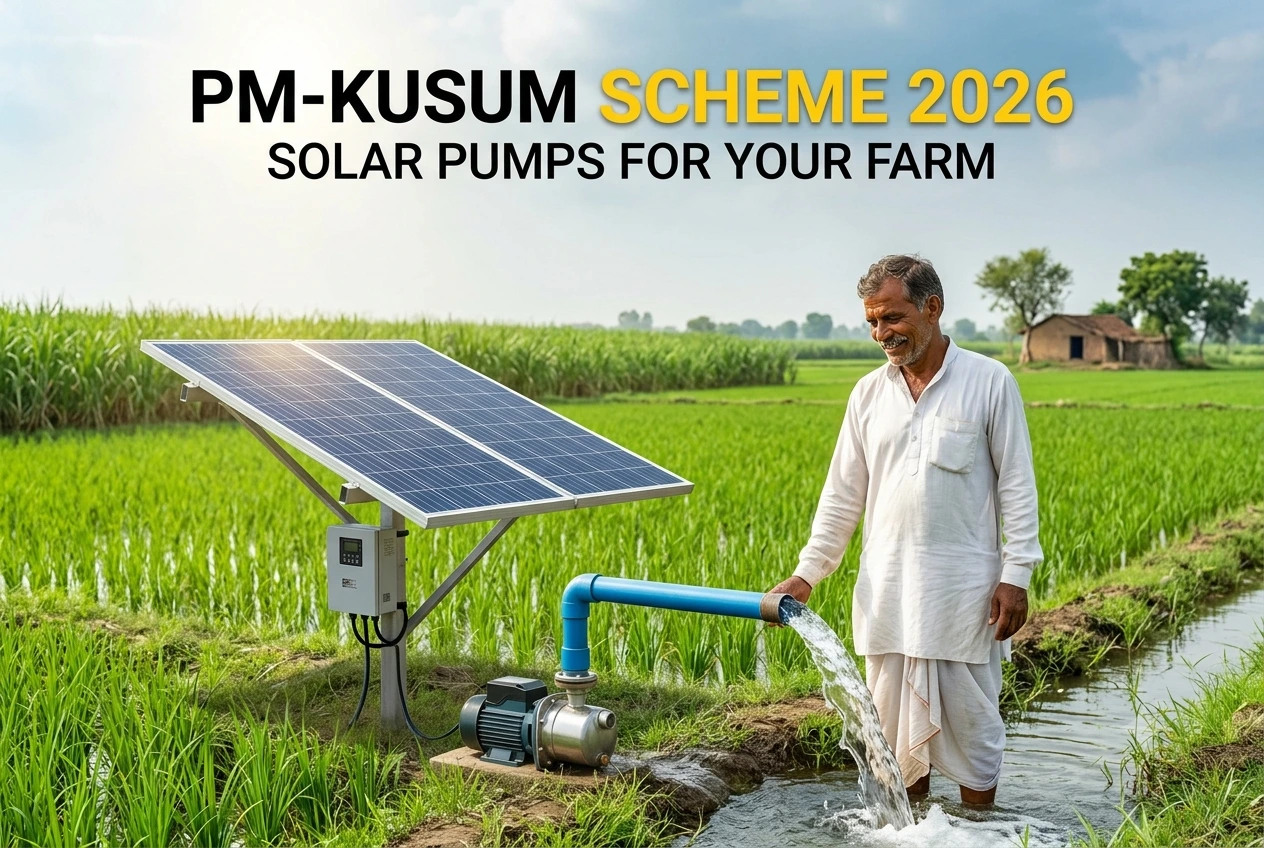
PM-KUSUM Scheme 2026: Get Up to 60% Subsidy on Solar Pumps for Your Farm
Every irrigation season, diesel and electricity costs quietly reduce farm profits. Diesel pumps can take a significant share of a farmer's operating expenses, while unreliable grid power can make timely irrigation difficult. The PM-KUSUM scheme was introduced to address these challenges by helping farmers adopt solar-powered irrigation systems at a significantly lower cost.
If you've been avoiding the scheme because the rules and application process seem complicated, this guide explains PM-KUSUM in simple terms, what it offers, who can apply, how the subsidy works, how much you may have to pay, and how to apply.
What is PM-KUSUM?
PM-KUSUM stands for Pradhan Mantri Kisan Urja Suraksha evam Utthaan Mahabhiyan. It’s a government scheme implemented through the Ministry of New and Renewable Energy (MNRE) to encourage farmers to adopt solar energy for irrigation and reduce dependence on diesel and conventional electricity.
The scheme can help farmers lower irrigation costs while providing more reliable access to daytime power. For farmers who install larger grid-connected solar systems, PM-KUSUM can also create an opportunity to earn additional income by supplying surplus electricity to the grid.
The PM-KUSUM Scheme continues to expand across India, with solar pumps and solarized agricultural connections being added in several states. A proposed next phase is also expected to focus on newer models such as agrivoltaics and energy storage.
In Budget 2026, the government nearly doubled its allocation for the scheme, raising it from ₹2,600 crore to ₹5,000 crore, and a much larger PM-KUSUM 2.0 phase reportedly with a ₹50,000 crore outlay covering agro-PV models and battery storage is currently being finalized. Over 10 lakh solar pumps have already been installed or solarized under the scheme so far, so this is not a small pilot program, it's a scheme actively scaling up right now.
The Three Components of PM-KUSUM
PM-KUSUM is divided into three major components. The right component depends mainly on your existing electricity connection, irrigation pump, and available land.
Component A → Grid-Connected Solar Power Plants
Component A allows farmers, farmer groups, cooperatives, Farmer Producer Organisations (FPOs), panchayats and similar entities to establish relatively small grid-connected solar power plants, generally on barren or unused land.
The electricity generated can be supplied to the local DISCOM under the applicable power-purchase arrangement. This component is particularly suitable for farmers who have suitable land and are interested in generating income from solar power rather than using solar only for irrigation.
Component B → Standalone Solar Pumps
Component B is the option most individual farmers associate with PM-KUSUM. It supports the installation of standalone solar-powered agricultural pumps, particularly in areas where farmers depend on diesel pumps or do not have a reliable grid connection for irrigation.
Depending on the state and applicable guidelines, eligible systems can include pumps in different capacities, commonly ranging from 3 HP to 10 HP.
Component C → Solarization of Existing Grid-Connected Pumps
Component C is designed for farmers who already have grid-connected agricultural pumps.
Under this component, an existing pump can be solarized by installing a suitable solar PV system. Farmers can use the generated solar power for irrigation, while surplus electricity may be supplied to the grid where the applicable state programme allows it.
How Much Subsidy Do You Actually Get?
This is one of the most important parts of PM-KUSUM and also one of the most misunderstood.
Under the standard funding structure, the Central Financial Assistance (CFA) can cover 30% of the benchmark cost of an eligible solar pump. State governments generally provide an additional subsidy, often around 30%, subject to the state's own implementation guidelines. This means the combined government support can reach around 60% in many cases, leaving the farmer to arrange the remaining amount.
For example, if an eligible pump has a benchmark cost of ₹2 lakh and the applicable combined subsidy is 60%, the subsidy could be approximately ₹1.2 lakh, leaving ₹80,000 to be arranged by the farmer, subject to the applicable state rules and benchmark cost. Farmers may also be eligible for institutional financing for their contribution, depending on the state programme and participating financial institutions.
A few important points to remember:
- The actual subsidy is state-specific. Your state may have different contribution percentages, pump capacities, benchmark costs or application rules.
- Higher CFA provisions may apply in certain special-category states and regions, including the North Eastern states, Jammu & Kashmir, Himachal Pradesh, Uttarakhand, Ladakh and island territories, subject to current MNRE guidelines.
- Some states may provide additional assistance to specific beneficiary categories.
- Subsidy is generally calculated against the applicable benchmark cost, so it should not automatically be assumed to be 60% of whatever price a vendor quotes.
Before making a financial decision, always check the latest subsidy and beneficiary contribution published by your state's implementing agency.
Who Can Apply to the PM-KUSUM Scheme?
The eligibility requirements vary depending on the component and state, but PM-KUSUM is not limited only to large farmers.
Broadly, eligible beneficiaries can include:
- Individual farmers with eligible agricultural land
- Groups of farmers and farmer cooperatives
- Farmer Producer Organisations (FPOs)
- Panchayats and other eligible rural organisations
- Farmers with suitable land for solar projects under the applicable component
- Farmers meeting the electricity-connection requirements applicable to standalone or grid-connected pumps
For Component B, the eligibility criteria generally focus on farmers who need a standalone solar irrigation pump and meet the conditions specified by the implementing state agency.
Commonly requested documents may include:
- Aadhaar or other accepted identity proof
- Land ownership or cultivation records
- Bank account details or passbook
- Existing electricity connection details, where applicable
- Details of the irrigation source, such as a borewell, open well or other approved water source
Because individual states can set additional conditions, always check the latest eligibility requirements before submitting your application.
How to Apply for PM-KUSUM: Step by Step
1. Start with the Official PM-KUSUM Information
Start at the central portal. Visit pmkusum.mnre.gov.in for scheme information and a directory link to your state's implementing agency.
2. Find Your State's Implementing Agency
The actual application is generally handled through the designated state department, renewable energy agency, DISCOM or another authorised implementing agency.
For example, different states use their own agencies and portals to manage beneficiary registration, verification and vendor selection like MEDA (Mahaurja) in Maharashtra and UPNEDA in Uttar Pradesh.
3. Register & Submit Your Application
Enter your personal information, land details, irrigation information and other details requested by the state portal. Make sure your name and other information match your official documents.
4. Upload the Required Documents
Keep your identity proof, land records, bank details and any other documents requested by your state ready before starting the application.
Incorrect or mismatched information can delay verification, so check everything carefully before submitting.
5. Site Verification & Vendor Selection
After preliminary approval, the implementing agency may conduct site verification. Depending on the state process, you may then select a solar pump and vendor from the approved or empanelled list.
Do not make payments to an unauthorised person claiming to arrange a PM-KUSUM pump or subsidy.
6. Installation & Subsidy Adjustment
Once the application and site are approved, the selected vendor installs the solar pump according to the programme requirements.
The applicable subsidy is generally adjusted as part of the scheme financing, meaning the farmer pays the required beneficiary contribution rather than paying the entire system cost upfront.
If you need assistance with the online process, you can also approach a Common Service Centre (CSC) or the relevant state implementing agency.
Why Solar Pumps Can Matter for Farm Income
The biggest advantage of a solar irrigation pump is not simply the subsidy, it is the potential reduction in recurring irrigation expenses.
Farmers using diesel pumps can face continuing fuel and maintenance costs. Grid-connected farmers may also face challenges when electricity supply is available only during specific hours. Solar pumps can provide access to daytime solar power for irrigation, potentially reducing dependence on diesel and improving irrigation planning.
Solar panels can also have a long operating life, with many modules designed to continue generating electricity for decades. The pump, controller and other components have their own warranties and maintenance requirements, so farmers should compare the warranty and after-sales service offered by approved vendors.
Solar pumps are only one part of the shift toward more efficient farming. Farmers can also reduce water wastage through drip irrigation, sprinklers, micro-sprinklers and sensor-based systems.
Read our guide to modern irrigation technologies and subsidies in India to understand the available irrigation methods and government support. For farmers who regularly spend money on diesel or face unreliable electricity supply, the long-term economics of solar irrigation can therefore be worth considering.
|| How to Reduce Farming Costs: Strategies
Reduce Irrigation Costs with PM-KUSUM Scheme
PM-KUSUM can make solar irrigation significantly more affordable for eligible farmers, but the actual subsidy, pump capacity, farmer contribution and application process depend on the state and the component you apply under.
If you're currently spending heavily on diesel or struggling with unreliable agricultural electricity, it may be worth checking whether your farm qualifies for a subsidised solar pump.
The most important step is to avoid relying on generic subsidy figures alone. Check your state's latest PM-KUSUM notification, beneficiary contribution, approved pump specifications and empanelled vendors before making any payment or purchase decision.
At Khetavya, we'll continue tracking PM-KUSUM updates, state-wise subsidy changes, new solar pump programmes and developments around the next phase of the scheme, so bookmark this page and check back before you apply.
Disclaimer: Subsidy percentages, eligibility conditions, allocations, pump capacities and application procedures mentioned in this article are based on publicly available information and may change as government and state-level guidelines are updated. The actual benefit available to a farmer depends on the applicable PM-KUSUM component and state rules. Always verify the latest information with MNRE and your state's authorised implementing agency before applying.