
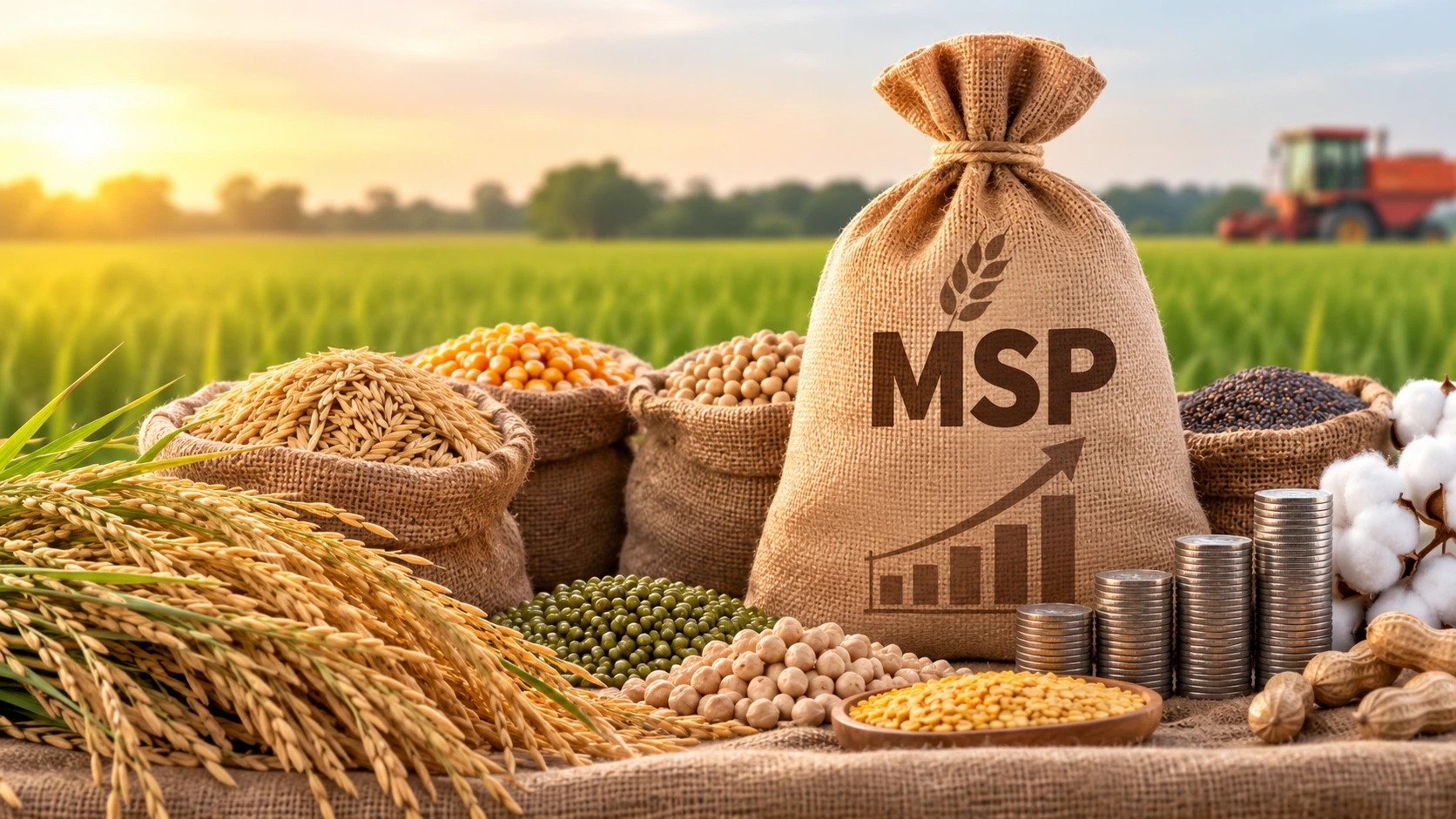
MSP (Minimum Support Price): Crop List, Latest Rates & How to Sell at MSP
Every sowing season, farmers want to know one thing: what is the MSP for their crop this year? Knowing the rate is important, but it is equally important to understand how MSP procurement works and where farmers can actually sell their produce at the declared price.
The Minimum Support Price (MSP) is announced by the central government for major agricultural crops. This guide covers the complete Kharif and Rabi MSP rates for 2025-26, how MSP is calculated, and the key steps farmers should know before selling their produce.
What is MSP?
Minimum Support Price (MSP) is a government-declared price for specified crops. It is intended to protect farmers from distress selling when market prices fall significantly after harvest.
The MSP for crops is recommended by the Commission for Agricultural Costs and Prices (CACP) and approved by the Cabinet Committee on Economic Affairs (CCEA).
Since the 2018-19 Union Budget, the government's stated policy has been to set MSP at at least 1.5 times the all-India weighted average cost of production. The government currently announces MSP for 22 mandated crops, covering Kharif and Rabi seasons, along with separate pricing mechanisms for certain commercial crops.
It is important to understand that MSP is not the same as the price every private trader must pay. Government procurement is what enables farmers to sell eligible produce at MSP when procurement is active.
Kharif MSP 2025-26: Complete Crop List
The CCEA approved MSPs for 14 Kharif crops for the 2025-26 marketing season in May 2025. The largest increase was for nigerseed, followed by ragi, cotton and sesamum.
Crop |
MSP 2025-26 (₹/quintal) |
Increase |
|---|---|---|
| Paddy (Common) | ₹2,369 | ₹69 |
| Paddy (Grade A) | ₹2,389 | ₹69 |
| Jowar (Hybrid) | ₹3,699 | ₹328 |
| Jowar (Maldandi) | ₹3,749 | ₹328 |
| Bajra | ₹2,775 | ₹150 |
| Ragi | ₹4,886 | ₹596 |
| Maize | ₹2,400 | ₹175 |
| Tur (Arhar) | ₹8,000 | ₹450 |
| Moong | ₹8,768 | ₹86 |
| Urad | ₹7,800 | ₹400 |
| Groundnut | ₹7,263 | ₹480 |
| Sunflower Seed | ₹7,721 | ₹441 |
| Soyabean (Yellow) | ₹5,328 | ₹436 |
| Sesamum | ₹9,846 | ₹579 |
| Nigerseed | ₹9,537 | ₹820 |
| Cotton (Medium Staple) | ₹7,710 | ₹589 |
| Cotton (Long Staple) | ₹8,110 | — |
The official government data lists these MSPs for Kharif Marketing Season 2025-26.
Among these crops, nigerseed received the highest increase of ₹820 per quintal, followed by ragi at ₹596, cotton at ₹589 and sesamum at ₹579.
The MSP also represents different margins over the government's estimated production cost. Bajra has a 63% margin, while maize and tur have a 59% margin and urad has a 53% margin. The remaining listed crops have a 50% margin based on the government's cost estimates.
Rabi MSP 2025-26: Complete Crop List
Rabi crops are covered under the Rabi Marketing Season (RMS) 2025-26. The government announced MSPs for six major Rabi crops.
Crop |
MSP 2025-26 (₹/quintal) |
|---|---|
| Wheat | ₹2,425 |
| Barley | ₹1,980 |
| Gram | ₹5,650 |
| Masur (Lentil) | ₹6,700 |
| Rapeseed & Mustard | ₹5,950 |
| Safflower | ₹5,940 |
Apart from these, MSP is also announced separately for commercial crops such as jute and copra, which follow their own marketing-season arrangements.
How to Sell Your Crop at MSP: Step by Step
Knowing the MSP rate does not automatically mean that a farmer can sell at that price anywhere. Procurement depends on the crop, state, procurement agency, quality requirements and active procurement window.
Step 1: Check Whether MSP Procurement Is Open
First, confirm whether your crop is currently being procured at MSP in your state.
Paddy and wheat have extensive government procurement networks through the Food Corporation of India (FCI) and state agencies, while pulses, oilseeds and other crops may be procured through designated agencies and programmes when applicable.
Farmers can check their state procurement portal, agriculture department or nearest mandi/procurement centre for current procurement dates and locations.
Step 2: Register With the Procurement System
Many states require farmers to register before delivering produce to a government procurement centre.
The registration process varies by state. It may involve an online procurement portal, agriculture department system or another designated platform.
Farmers should complete registration before the procurement deadline rather than waiting until harvest.
Step 3: Keep Your Documents Ready
The exact requirements differ by state, but farmers may generally be asked for:
- Aadhaar card
- Bank account details
- Land ownership or cultivation records (7/12 extract, khatauni, or equivalent depending on your state)
- Crop sowing details or declaration
- Other state-specific registration documents
Make sure the name and bank details submitted during registration are accurate to avoid payment delays.
Step 4: Prepare Produce According to Quality Standards
Government procurement centres generally accept produce that meets the prescribed Fair Average Quality (FAQ) specifications.
Excess moisture, foreign matter, damaged grains or poor-quality produce can result in rejection or deductions.
Farmers should therefore properly dry, clean and grade their produce before taking it to the procurement centre.
Step 5: Take the Produce to the Designated Centre
After registration, farmers can take their produce to the designated procurement centre or mandi during the permitted procurement period.
The produce is weighed and checked for quality. Once accepted, the farmer should receive documentation showing the quantity procured.
Step 6: Receive Payment
Payment is generally transferred to the farmer's registered bank account according to the procurement system and state-level process.
Farmers should keep their procurement receipt and other transaction records until the payment has been received and verified.
What to Do If a Private Buyer Offers Less Than MSP?
This is one of the most misunderstood aspects of MSP.
For most crops, MSP does not mean that every private trader is legally required to purchase the crop at or above MSP. MSP primarily operates through government procurement and related market-support mechanisms.
If a private buyer offers less than MSP, farmers can consider:
- Selling through an active government procurement centre, if eligible
- Comparing prices at nearby mandis before making a decision
- Storing the crop temporarily if suitable storage is available
- Selling collectively through a Farmer Producer Organisation (FPO)
- Reporting suspected practices such as under-weighing or other mandi irregularities to the relevant authorities
The right option depends on the crop, local market price, storage costs and whether government procurement is currently open.
MSP vs Open Market Price: Which is Better?
MSP is a safety net, not necessarily the highest price available.
If mandi prices are above MSP because of strong demand or limited supply, selling in the open market may provide a better return. When market prices fall below MSP, government procurement can become more valuable to eligible farmers.
Before selling, compare the current mandi price through the e-NAM price dashboard or local mandi bulletins, MSP, transport costs, quality deductions and storage costs rather than looking at MSP alone.
Common MSP Mistakes Farmers Should Avoid
A few simple mistakes can prevent farmers from getting the benefit of procurement:
- Missing the registration deadline: Procurement registration often closes before or during the harvest period.
- Ignoring quality requirements: Produce that does not meet FAQ standards may be rejected or subject to deductions.
- Using outdated MSP rates: MSP changes from one marketing season to another.
- Not checking procurement status: An MSP may be officially announced even when procurement for a particular crop or location is not currently open.
- Selling without comparing prices: A local mandi may offer more than MSP, making an open-market sale more profitable.
- Ignoring collective selling: FPOs and farmer groups can sometimes improve bargaining power and reduce individual transaction costs.
MSP 2025-26: Know the Rates Before You Sell Your Crop
MSP provides farmers with an important price-support mechanism, but knowing the announced rate is only the first step. Before selling, farmers should check whether procurement is active for their crop and state, complete registration on time, meet quality requirements, and compare the MSP with the prevailing mandi price.
Keeping track of MSP rates, mandi prices, procurement updates and crop-related information can help farmers make better selling decisions. Platforms such as Khetavya can also make it easier to stay informed about important agricultural updates and market information.
For the 2025-26 season, farmers should always verify the latest procurement schedule and requirements with the relevant government authority or procurement centre before taking their produce to market.