
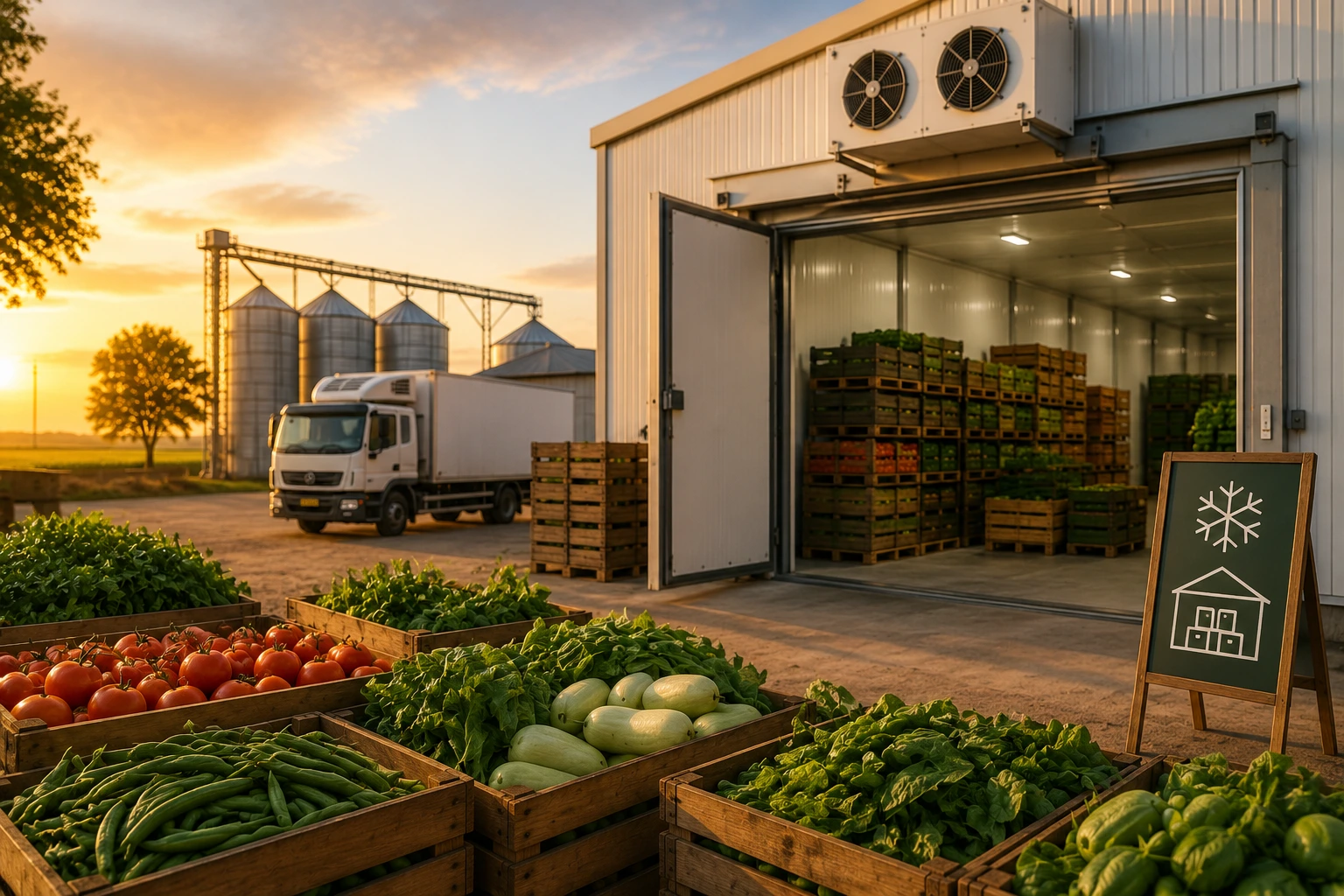
Cold Storage & Warehousing for Farmers: How to Cut Losses and Earn Better Prices
Harvest day may feel like the finish line, but for most farmers, it's actually the beginning of another critical challenge: protecting the crop until it can be sold at a profitable price.
Without proper storage, farmers usually face two difficult choices: sell immediately when market prices are at their lowest, or wait and risk spoilage. Neither option works in the farmer's favour.
Cold storage and scientific warehousing provide a better alternative. By storing produce safely, farmers can reduce post-harvest losses, avoid distress selling, access loans against stored crops, and sell when market prices are more favourable.
For many farmers, the right storage solution can increase profits just as much as improving crop yields.
Why Storage Matters More Than Most Farmers Realize
Immediately after harvest, markets receive large quantities of the same crop from surrounding farms. Prices drop because supply is high and everyone is selling at once.
Farmers who lack storage facilities are often forced to sell during this low-price period simply because they need immediate cash or have nowhere to keep their produce. This is commonly known as distress selling.
Storage changes this equation.
Instead of selling under pressure, farmers can safely store their harvest for weeks or even months and wait until demand improves and prices recover. In many cases, the timing of the sale has a greater impact on profits than the quantity harvested.
Types of Storage Options for Farmers
Different crops require different storage conditions. Choosing the right facility helps preserve quality, reduce spoilage, and maximize returns.
Cold Storage
Cold storage is ideal for highly perishable produce such as:
- Fruits
- Vegetables
- Flowers
These facilities maintain controlled temperature and humidity, slowing ripening, reducing spoilage, and extending shelf life from just a few days to several weeks.
Dry Warehouses
Dry warehouses are best suited for:
- Wheat
- Rice
- Pulses
- Oilseeds
- Maize
Although these crops don't require refrigeration, they must be protected from moisture, insects, rodents, and fungal growth.
Proper warehouse storage preserves quality for months while reducing quantitative and qualitative losses.
Village-Level and Cooperative Storage
Many Farmer Producer Organizations (FPOs) and cooperatives establish shared storage facilities for their members.
These community-based warehouses:
- Lower storage costs per farmer
- Reduce transportation expenses
- Make storage facilities accessible closer to the farm
- Improve collective bargaining power
Shared storage is particularly beneficial for small and marginal farmers who cannot afford private facilities.
On-Farm Storage Structures
Low-cost storage solutions like Zero Energy Cool Chambers (ZECCs) provide an affordable option for smaller farms.
Built using locally available materials, these structures naturally maintain lower temperatures and higher humidity than the surrounding environment. While they cannot replace commercial cold storage, they can significantly extend the shelf life of vegetables and fruits, especially in rural areas with limited infrastructure.
Using Stored Crops to Get a Loan: Understanding e-NWR
Here's a part most farmers don't know about: stored produce can be used to get a loan, without selling it.
When produce is stored in a warehouse registered with the Warehousing Development and Regulatory Authority (WDRA), the warehouse issues an electronic Negotiable Warehouse Receipt (e-NWR).
This receipt serves as legal proof of:
- Quantity stored
- Quality of produce
- Ownership
Banks accept e-NWRs as collateral and typically provide loans worth 70–80% of the market value of the stored produce.
This allows farmers to:
- Meet immediate financial needs
- Avoid distress selling
- Wait for better market prices
- Repay the loan after selling the crop
To encourage warehouse receipt financing, the Government of India has also introduced a Credit Guarantee Scheme for e-NWR-based lending, reducing risk for banks and making credit more accessible to farmers, FPOs, and cooperatives.
- Important: Only receipts issued by WDRA-registered warehouses are eligible for this facility. Always verify the warehouse's registration before storing produce.
Government Schemes Supporting Cold Storage and Warehousing
Building storage infrastructure requires significant investment, which is why several government schemes provide financial assistance to farmers, FPOs, cooperatives, and agri-entrepreneurs.
Agriculture Infrastructure Fund (AIF)
The AIF supports the construction of:
- Warehouses
- Cold storage facilities
- Primary processing centres
- Other post-harvest infrastructure
Key benefits include:
- Collateral-free loans up to ₹2 crore
- 3% interest subvention
- Interest support for up to 7 years
Eligible applicants include individual farmers, FPOs, cooperatives, self-help groups, and agri-entrepreneurs.
PMKSY – Integrated Cold Chain and Value Addition Infrastructure
Operated by the Ministry of Food Processing Industries, this scheme supports integrated cold chain projects.
Financial assistance includes:
- 35% capital grant in general areas
- 50% capital grant for FPOs, SHGs, SC/ST promoters, projects in North Eastern, Himalayan, and notified regions.
Unlike standalone cold storage projects, this scheme requires at least two linked components such as pre-cooling, refrigerated transport, processing, or storage.
National Horticulture Board (NHB) Capital Investment Subsidy
The NHB scheme supports the construction, expansion, and modernization of cold storage facilities for horticultural produce.
Available assistance:
- 35% subsidy in general areas
- 50% subsidy in hilly, North Eastern, and scheduled areas
The subsidy is credit-linked and released after project completion and inspection.
NABARD
Support NABARD provides affordable financing for warehouse development, food processing, and rural infrastructure through dedicated funding programs.
Since warehousing is covered under priority sector lending, farmers and agri-businesses often find it easier to secure loans for storage infrastructure.
- Note: Government schemes, subsidy percentages, eligibility criteria, and budgets are revised periodically. Always verify the latest guidelines with your bank or the relevant department before applying.
Who Can Apply and How?
Depending on the scheme, eligible applicants generally include:
- Individual farmers
- Farmer Producer Organizations (FPOs)
- Cooperatives
- Self-Help Groups (SHGs)
- Agri-entrepreneurs
Applications are usually submitted through:
- Banks (for AIF and NABARD-linked financing)
- State Horticulture Departments
- State Food Processing Departments
A Detailed Project Report (DPR) is often required for larger, loan-linked projects. For guidance, farmers can also approach their local Agriculture Officer or Krishi Vigyan Kendra (KVK) to understand eligibility, documentation, and the most suitable scheme.
How to Choose the Right Storage for Your Crop
Here's a simple guide to selecting the right storage option:
Crop Type |
Recommended Storage |
|---|---|
| Perishables (Fruits, vegetables, flowers) | Cold storage or Zero Energy Cool Chamber |
| Wheat, rice, pulses, oilseeds | Dry warehouse, ideally WDRA-registered if you plan to use it for a loan later |
| Small harvests | On-farm or village-level storage |
| Large harvests or produce intended for warehouse loans | WDRA-registered warehouse or commercial cold storage |
When choosing a facility, proximity matters as much as storage capacity. A nearby warehouse reduces transportation costs, minimizes handling damage, and helps maintain produce quality.
Benefits of Proper Storage
Investing in the right storage solution offers several long-term advantages:
- Reduces post-harvest losses and spoilage
- Allows farmers to sell when market prices improve
- Provides access to bank loans through e-NWRs
- Reduces dependence on distress sales and middlemen
- Improves bargaining power during negotiations
- Preserves crop quality and market value
Cold Storage and Warehousing: A Smarter Way to Increase Farm Profits
Successful farming doesn't end at harvest.
The decisions made after harvesting:
- how produce is stored
- when it is sold
- how working capital is manage
often determine the final income from an entire season.
Cold storage and scientific warehousing give farmers greater control over pricing, reduce unnecessary losses, and create opportunities to earn more from the same harvest. When combined with government support schemes and warehouse receipt financing, proper storage becomes a powerful tool for improving farm profitability.
At Khetavya, our post-harvest management services help farmers identify suitable storage solutions, connect with reliable facilities, understand government schemes, and make informed post-harvest decisions. Because protecting your harvest is just as important as growing it.