
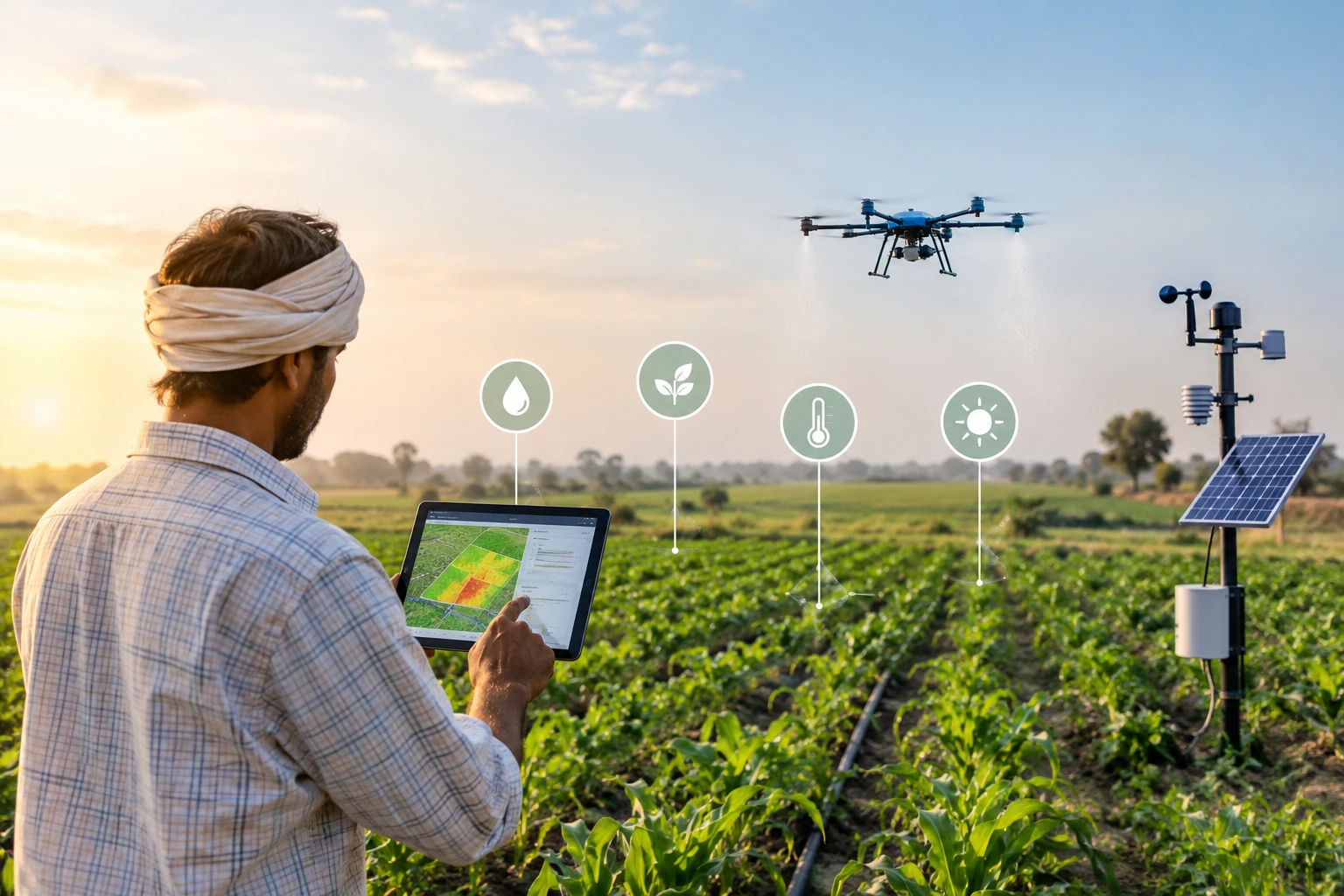
Smart Farming in India: Technologies, Cost, Benefits & Examples
Smart farming uses sensors, drones, weather data and mobile apps to help farmers apply the right amount of water, fertilizer and pesticide at the right time. In India, it is moving beyond pilot projects as input costs rise, groundwater declines and affordable, pay-per-acre services become more accessible.
Agriculture uses around 85% of India's water, and per-capita water availability was about 1,486 m³ in 2021, with a further fall projected. For farmers working on small, fragmented plots, using resources efficiently is increasingly important.
This guide covers key smart farming technologies, their benefits, real-world examples, cost considerations and practical steps to get started.
What is Smart Farming?
Smart farming uses real-time data from sensors, satellites, weather stations and apps to guide farming decisions. It is closely related to precision farming, which focuses on applying the right input in the right quantity, at the right place and time.
For example, instead of irrigating on a fixed schedule, a farmer can use soil moisture readings to decide when watering is necessary. Similarly, drone imagery and mobile apps can help identify crop stress or pest problems before they spread.
While precision farming focuses on targeted resource use, smart farming also includes IoT connected devices, AI-based advice and automation.
Why is Smart Farming Important in India?
Smart farming addresses several challenges faced by Indian farmers:
- Water scarcity: Soil moisture sensors and automated irrigation can reduce unnecessary watering.
- Rising input costs: Targeted fertilizer and pesticide application helps limit waste. Read our guide on how to reduce farming costs.
- Small landholdings: Renting equipment or sharing it through farmer groups makes technology more accessible.
- Labour shortages: Drones and automated irrigation reduce manual work.
- Better decision-making: Weather forecasts, soil data and crop monitoring help farmers make timely decisions.
Farmers do not need to adopt every technology at once. Starting with the biggest cost or risk is often the most practical approach.
Smart Farming Technologies Indian Farmers Should Know
These technologies cover most of what Indian farmers actually use today. Start with the one that fixes your biggest cost or risk, not all of them.
1. Soil and Moisture Sensors
Soil moisture sensors measure water availability in the root zone and send readings or alerts to a phone. Some models also measure temperature and other soil parameters. They are particularly useful for water-intensive crops such as paddy, sugarcane, cotton and vegetables. Before investing, establish a baseline through soil test before sowing and review your Soil Health Card.
2. IoT and Automated Drip Irrigation
Drip irrigation delivers water directly to plant roots. Timers, automated valves and moisture sensors can further improve irrigation scheduling. It is best for orchards, vegetables, cotton and sugarcane. Drip and sprinkler systems may qualify for government subsidies.
3. Agricultural Drones
Drones can spray pesticides, fertilizers and nano urea, while equipped cameras can help identify crop stress. They cover fields quickly and can reduce water use compared with conventional spraying. Many farmers hire drone services per acre rather than purchasing equipment.
4. Weather Stations and Advisory Apps
On-farm weather stations and hyperlocal forecasts help farmers plan sowing, irrigation and spraying. Alerts about rainfall, humidity and temperature can reduce the risk of applying chemicals at the wrong time. Government and private advisory apps also provide crop-stage recommendations through mobile notifications, SMS or voice messages.
5. Satellite Crop Monitoring
Satellite imagery helps track crop growth, identify uneven development and detect possible water stress or pest problems. Monitoring services are often available on a per-acre or per-season basis. They are best for Farmer Producer Organisations (FPOs), larger farms, insurers and sugar mills managing multiple plots.
6. Variable-Rate Technology
Variable-rate technology adjusts fertilizer or pesticide application according to differences across a field, using soil maps, sensors or crop imagery. It can reduce input waste, but requires reliable data and compatible machinery. Farmers should consider it after establishing accurate soil and crop records.
7. Farm Management Apps and Solar Pumps
Farm management apps help track expenses, field activities and crop performance. AI-based tools can also assist with identifying pests and diseases from photographs or other data.
Combining these tools with integrated pest management can support targeted treatment instead of unnecessary spraying. Solar pumps offer another practical option, particularly for farms facing unreliable electricity or high diesel costs.
For a broader overview of equipment, see our guide to farming tools and technologies.
How Much Does Smart Farming Cost in India?
The cost of smart farming depends on the technology, farm size, crop and service provider. Renting equipment or paying per acre can help farmers avoid large upfront investments.
Technology |
Indicative Cost |
How to Read It |
|---|---|---|
| Basic sensor network (4 sensor nodes, 1 gateway, solar panel) | ₹8,000–12,000 for about 2 acres, or ₹4,000–6,000 per acre | Do-it-yourself, hobby-grade kit; commercial systems with support cost more. |
| Weather and advisory apps | Free for many government and private apps | Cheapest first step for any farmer. |
| Drone spraying, hired | ₹400–800 per acre for the service alone; ₹700–1,200 with chemicals included | Compared with ₹800–1,500 per acre for manual spraying. |
| Drone, purchased | About ₹15 lakh for the IFFCO package in Sirsa, Haryana (drone, electric vehicle and generator) | Subsidy of 80% up to ₹8 lakh for women's self-help groups. |
| Solar pump, 3 HP | ₹1.8–2.5 lakh before subsidy | Farmer pays up to about 40% under PM-KUSUM Component B. |
| Solar pump, 5 HP | ₹3–3.5 lakh before subsidy | Same subsidy split; no official nationwide price list, so tenders vary by state. |
| Drip irrigation | Varies by crop spacing and area; get a quote from an approved vendor. | Subsidy of 55% for small and marginal farmers and 45% for others. |
Affordable ways to get started include:
- Use free weather and crop advisory apps for a season.
- Hire drones by the acre instead of buying them.
- Share equipment through a Custom Hiring Centre or FPO.
- Explore financing options such as the Kisan Credit Card for eligible working-capital needs.
Farmers should also check current state and central subsidy eligibility before purchasing equipment.
Benefits of Smart Farming
Smart farming can improve profitability by reducing waste and helping farmers maintain or improve yields.
- Lower input use: Sensors and targeted spraying help reduce unnecessary water, fertilizer and pesticide application.
- Better crop performance: Timely irrigation and nutrient management reduce crop stress.
- Earlier pest detection: Monitoring tools help identify problems before they spread.
- Reduced labour requirements: Drone spraying can take under 15 minutes per acre under suitable conditions, compared with several hours for manual spraying.
- Improved records: Digital logs of expenses, inputs and yields can support financial planning and applications for crop insurance.
For example, drone spraying may use around 10–15 litres of water per acre, compared with 200–250 litres for manual spraying, according to AgriFarming. Actual savings depend on the equipment, crop and operating conditions.
Examples of Smart Farming in India
Smart farming approaches are being applied across different crops and regions.
- Gujarat: Soil moisture probes connected to drip irrigation in pomegranate and cotton farming in Idar have been associated with reported reductions in water consumption and fruit cracking.
- Maharashtra: Drone-based crop imagery in Nashik vineyards can help identify crop stress and downy mildew, allowing more targeted spraying.
- Punjab: Satellite-guided nitrogen application and laser land levelling can improve fertilizer efficiency in paddy-wheat farming.
- Kerala: Weather monitoring in coffee and spice plantations helps farmers time fungicide applications around rainfall and humidity.
The Indian Council of Agricultural Research (ICAR) and state digital agriculture initiatives also support smart-farming pilots involving shared digital infrastructure, pest detection and sensor-based advisory tools.
Results vary by crop, location and implementation, so farmers should assess local suitability before investing.
Government Schemes and Subsidies for Smart Farming
Government schemes can help reduce the cost of adopting eligible agricultural technologies. Depending on the scheme and state, support may be available for micro-irrigation, solar pumps, machinery and shared equipment.
Scheme |
Coverage / Scope |
|---|---|
| Digital Agriculture Mission | Open digital public infrastructure, AI advisories, soil mapping. |
| PM-KUSUM | Up to 60% subsidy on stand-alone and feeder-level solar pumps. |
| Sub-Mission on Agricultural Mechanization (SMAM) | 40–50% subsidy for drone purchase; up to 100% for agri-institutions. |
| Per Drop More Crop (PDMC) | Financial assistance for micro-irrigation (drip/sprinkler) and sensors. |
| Agri Infrastructure Fund (AIF) | 3% interest subvention on loans for post-harvest and smart infrastructure. |
Smart Farming Challenges and How to Overcome Them
The biggest barriers to smart farming are upfront cost, skills and connectivity, and each has a practical workaround that does not require a large farm.
- High upfront costs: Purchasing smart equipment outright is beyond most smallholders. Rent equipment or share it through FPOs and Custom Hiring Centres.
- Complex apps: Complex app interfaces slow adoption. Choose local-language tools, SMS alerts or voice-based advisories.
- Poor internet connectivity: Rural networks are dead zones. Consider sensors that store data offline and sync when connectivity returns.
- Small plots: Small field sizes reduce the efficiency of heavy machinery. Coordinate with neighbouring farmers to share equipment and service costs.
A demonstration from a local agricultural extension worker can also help farmers understand how a technology works before investing.
How to Start Smart Farming: Step by Step
Start with one problem and one tool, measure it for a full season, then scale.
1. Test Your Soil
Get a soil test or update your Soil Health Card to understand nutrient levels, pH, micronutrients and other relevant parameters.
2. Identify One Core Problem
Determine your biggest cost driver whether it is high diesel bills for irrigation, frequent pest outbreaks, or excessive fertilizer expenditure.
3. Choose One Affordable Solution
Start with a free or low-cost solution: download a satellite monitoring app, install a simple soil moisture indicator, or book a rented drone for your next spray.
4. Measure Results
Record input costs, water use, labour hours and yields. Compare them with previous seasons or a similar plot managed using conventional methods.
5. Expand Gradually
If the technology delivers measurable benefits, reinvest the savings in automation, improved irrigation or solar pumping. Check applicable schemes such as PM-KUSUM or SMAM before investing.
Smart Farming: Start Small, Scale What Works
Smart farming is becoming more accessible to Indian farmers through affordable digital tools, equipment rentals and shared services. From soil moisture sensors and drip irrigation to drones and AI-powered crop monitoring, these technologies can help reduce input waste, conserve water and improve farm management.
The best approach is to start with one problem, test one suitable technology for a full season and measure the results before expanding.
Khetavya can help you find agricultural equipment, inputs and buyers near you.