
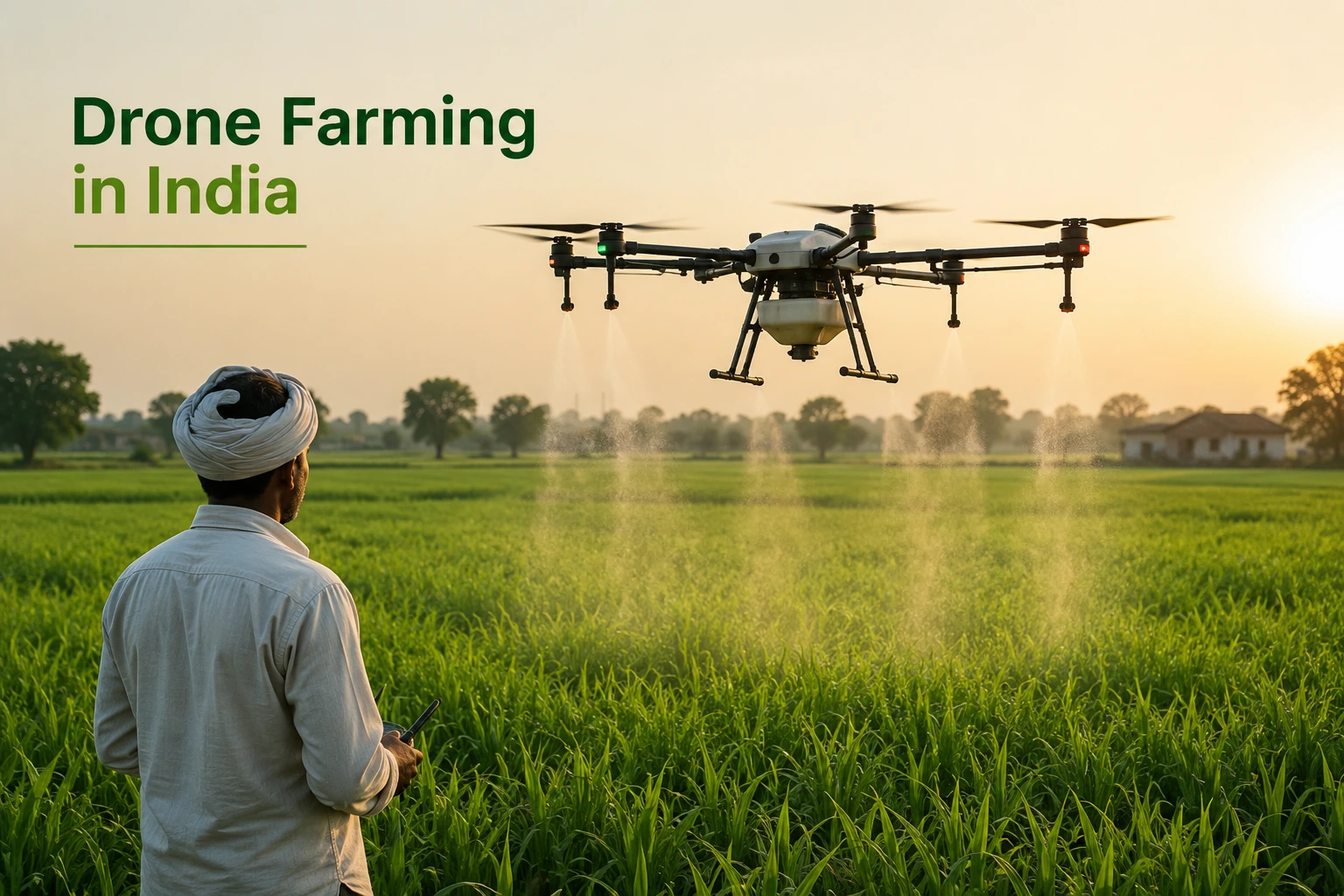
Drone Farming in India: Uses, Cost and Subsidies Farmers Can Avail
Farming in India has never been easy. Labour is getting harder to find, input costs keep rising, and one bad season can undo months of hard work. Farmers are constantly looking for ways and technologies that improve efficiency and reduce waste.
That is where agricultural drones are making a real difference.
What once seemed like a futuristic concept is now becoming a practical tool on farms across Maharashtra, Punjab, Rajasthan, Andhra Pradesh, Karnataka, and many other states. Farmers are using drones for spraying pesticides, monitoring crop health, mapping fields, and even sowing seeds.
If you are considering drone technology for your farm, this guide explains how agricultural drones work, their applications, approximate costs, and the government subsidies available to support adoption.
What is Drone Farming?
Simply put, drone farming means using Unmanned Aerial Vehicles (UAVs) to perform tasks that traditionally required manual labour or ground-based machinery.
In Indian agriculture, three main types of drones are used:
- Spraying drones: For applying pesticides, fertilizers, and crop protection products
- Mapping drones: For surveying fields and collecting crop data
- Surveillance drones: For monitoring crop health across large areas and identifying issues early
→ It is important to note that commercial drone operations in India require a Remote Pilot License (RPL) issued by the Directorate General of Civil Aviation (DGCA) under the Drone Rules, 2021. If you plan to hire a drone service provider, ensure the operator is properly licensed and compliant with regulations.
Key Uses of Drones in Agriculture
1. Spray Pesticides and Fertilizers
Spraying is currently the most common agricultural use case for drones in India.
A drone equipped with a 10–16 litre tank can cover an acre in around 7–10 minutes. In comparison, manual spraying may take 2-3 hours depending on crop conditions and field size.
Apart from saving time, drone spraying offers:
- More uniform coverage
- Better penetration into crop canopies
- Reduced exposure of workers to chemicals
- More precise application, which can help reduce wastage
Drones are also increasingly used for spraying nano-fertilizers such as nano-urea, where uniform distribution is important for effectiveness.
2. Seed Broadcasting and Sowing
Agricultural drones can distribute seeds across fields quickly and efficiently.
This is particularly useful for:
- Direct seeding of paddy
- Wheat cultivation
- Hilly or uneven terrain
- Waterlogged fields where machinery access is difficult
Seed broadcasting through drones can help speed up operations during narrow sowing windows and reduce dependence on labour availability.
3. Crop Health Monitoring
Mapping drones capture high-resolution aerial images that provide valuable insights into crop conditions.
Using these images, farmers can identify:
- Nutrient deficiencies
- Pest infestations
- Disease outbreaks
- Water stress
One of the biggest advantages is early detection. Problems can often be identified before visible symptoms appear, allowing corrective action to be taken sooner and reducing potential crop losses.
4. Field Mapping and Land Assessment
Drones can generate detailed maps of agricultural land within a short period of time.
These maps help farmers understand:
- Field boundaries
- Elevation variations
- Drainage patterns
- Areas with uneven productivity
Such information can support better land management decisions and improve resource allocation across the farm.
5. Irrigation Management
Thermal cameras on drones can spot areas that are too dry or waterlogged.
This enables farmers to:
- Detect irrigation issues early
- Improve water-use efficiency
- Reduce unnecessary water consumption
- Optimize drip and sprinkler irrigation systems
In regions facing water scarcity, this capability can be especially valuable.
6. Large-Scale Pest Control
When a pest outbreak covers a large area quickly like the locust invasion in 2020, drones allow a rapid, coordinated response that ground teams simply cannot match. State governments and ICAR have already used drones extensively for this.
How Much Does an Agricultural Drone Cost in India?
Cost is usually the first question farmers exploring drone technology ask, and rightly so. The approximate pricing is as follows:
| Type of Drone | Approx. Price |
|---|---|
| Basic sprayer drone (10L tank) | ₹4 – 6 lakh |
| Mid-range sprayer drone (16L tank) | ₹6 – 10 lakh |
| Advanced drone with mapping + sprayer | ₹12 – 20 lakh |
| Hiring a drone service (per acre) | ₹400 – 800 |
Additional Operating Costs
Beyond the purchase price, keep these running costs in mind:
- Battery replacement (typically every 300–500 charge cycles)
- Routine maintenance and repairs
- Software updates where applicable
- Remote pilot fees if you are not operating it yourself
These ongoing expenses should be considered when evaluating the overall investment.
Should You Buy a Drone or Hire One?
The right choice depends largely on farm size and frequency of use.
Buying a Drone May Make Sense If:
- You cultivate a large area regularly
- Multiple spray cycles are required each season
- You plan to provide drone services to neighbouring farmers
- You are part of an FPO or cooperative that can share ownership costs
Hiring a Drone Service May Be Better If:
- You have a smaller landholding
- Drone usage is limited to a few operations each season
- You want to evaluate the technology before investing
Today, many Farmer Producer Organisations (FPOs), cooperatives, and private service providers offer drone spraying on a pay-per-acre basis, making the technology accessible without a major upfront investment.
Government Subsidies on Agricultural Drones
To encourage precision farming and technology adoption, both central and state governments have introduced financial assistance programs for agricultural drones.
Sub-Mission on Agricultural Mechanisation (SMAM)
Under SMAM, the central government offers subsidies on farm machinery including drones:
- Up to 50% subsidy for SC/ST farmers, women farmers, and small or marginal farmers
- Up to 40% subsidy for other eligible farmer categories
Applications go through your state agriculture department. Check your state's agriculture portal or visit the nearest agriculture office to apply.
ICAR and Krishi Vigyan Kendras (KVKs)
If you want to understand drone operations before spending any money, you can approach the nearest KVK.
Many KVKs:
- Conduct live drone demonstrations
- Organize awareness programs
- Offer training sessions
- Facilitate access to drone-based services
These programs help farmers assess practical benefits under local farming conditions
Namo Drone Didi Scheme
The Namo Drone Didi Scheme, launched in 2024, aims to empower women's Self-Help Groups (SHGs) through drone technology.
- 15,000 drones are being provided to SHGs across the country
- Financial assistance of up to ₹8 lakh per drone
- Training for drone operation and maintenance
- Opportunities for SHGs to generate income by providing drone spraying services
This is a solid model. It puts drones in communities while creating a source of income for women farmers. If your village has an active SHG, it is worth finding out if they have applied or are eligible.
State-Level Drone Subsidy Programs
Several states also offer additional support beyond central government schemes.
Examples include:
- Maharashtra: Additional subsidy under the Chief Minister's Shetkari Yojana
- Haryana: Drone subsidy for cooperative farming groups
- Rajasthan: Benefits linked to FPO participation in some programs
- Uttar Pradesh: Various technology adoption incentives through agriculture departments
Since state policies and budgets can change periodically, farmers should consult local agriculture offices or official state agriculture portals for the latest information.
How to Apply for a Drone Subsidy
Farmers interested in availing subsidies can follow these steps:
- Visit your nearest Krishi Vigyan Kendra or District Agriculture Office. They can provide guidance on current eligibility requirements and application procedures.
- Apply on the DBT Agriculture portal.
- Keep required documents ready including land records (khatauni / 7/12 extract), Aadhaar card, Bank account details linked to Aadhaar, caste certificate (where applicable), any additional documents specified by the state government.
Processing timelines vary, but applications are typically reviewed within 4-8 weeks, depending on the scheme and state.
How Drones Can Add Value to Your Farm
Drones work well for farms above 2 acres, particularly for crops like paddy, wheat, cotton, sugarcane, and horticulture (mango, grapes, pomegranate). Orchards especially benefit because canopy coverage is uneven and ground sprayers often miss sections.
Even farmers with smaller holdings can benefit through drone-on-hire services or shared ownership models offered by FPOs and cooperatives.
In terms of returns, most farmers who spray using drones report savings of 20–30% on pesticide costs (because drone application is more precise) and significant savings on labour.
For a 5-acre cotton farm, for example, the reduction in spraying labour alone across a season can be meaningful.
Actual savings will vary depending on crop type, farm size, and local conditions.
Is Drone Farming the Next Step for Your Farm?
Agricultural drones are gradually becoming a practical tool for modern farming in India. While they may not replace every traditional farming practice, they can significantly improve efficiency in areas such as spraying, crop monitoring, field mapping, and irrigation management.
With government subsidies, growing service networks, and increasing awareness among farmers, drone technology is becoming more accessible than ever before.
For farmers looking to reduce labour dependency, improve precision, and adopt smarter farming practices, exploring drone-based solutions is worth considering. Whether through direct ownership, shared access via FPOs, or hiring drone services when needed, the technology offers a flexible pathway toward more efficient and data-driven agriculture.
At Khetavya, we are committed to helping farmers navigate these advancements with practical insights, expert guidance, and up-to-date information on modern farming technologies.